Monte Cecilia, Mountain summit in Euganean Hills, Italy
Monte Cecilia is a mountain in the Euganean Hills that rises 199 meters and sits in the Veneto region of northeastern Italy. The peak forms part of a distinctive range of rounded hills shaped by volcanic activity millions of years ago.
The mountain formed millions of years ago through volcanic activity that shaped the entire Euganean range. Local communities settled around these hills, adapting their agricultural patterns to the terrain over many centuries.
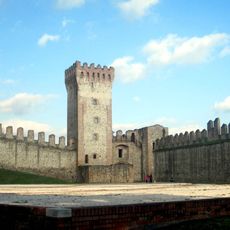
The hill's name comes from the adjacent village of Baone, whose trails and roads start the climb and circle Monte Cecilia and the castle ruins on its summit. The red scaglia limestone and latite outcrops here are studied for onion-skin exfoliation, described by the English ambassador John Strange in his 1778 work on Veneto volcanism.
Trails and minor roads leave from the village of Baone, next to the hill, and allow both the ascent and the circuit of Monte Cecilia and the castle ruins on its summit. The slopes expose red scaglia limestone and latite, with onion-skin exfoliation visible on the rock faces.
The hill is a rare Italian site of latite, an effusive magmatic rock also found in Tuscany, Lazio and the Aeolian Islands, and its slopes show onion-skin exfoliation studied by the English ambassador John Strange (1732–1799) in his 1778 work on Veneto volcanism.
The community of curious travelers
AroundUs brings together thousands of curated places, local tips, and hidden gems, enriched daily by 93,764 contributors worldwide.