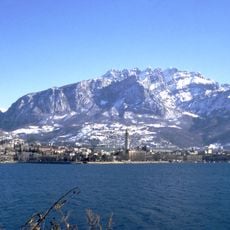
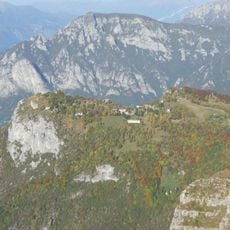
Monte Due Mani, Mountain summit in Valsassina, Italy.
Monte Due Mani is a 1,666-metre mountain of the Bergamasque Prealps in the province of Lecco, one of the first high reliefs on the southern edge of the Alps. Its bedrock is sedimentary limestone and dolomite, mainly Dolomia Principale. A long watershed ridge separates a regular western slope facing the Valsassina from the more broken Morterone side, where rock outcrops and karst corrosion grooves and basins are frequent.
Leonardo da Vinci drew Monte Due Mani on sheet 12410 of the Windsor Codex, with the Pizzo dei Tre Signori behind it; similar forms appear on a sheet of his Codex Resta. The mountain rises to 1,666 m in the Bergamasque Prealps, between the Valsassina, Lake Como and the Grigna and Resegone massifs.
Leonardo da Vinci drew Monte Due Mani and the Pizzo dei Tre Signori behind it in the Windsor Codex (sheet 12410), and similar forms appear on a sheet of his Codex Resta. The mountain is climbed from Culmine di San Pietro, a pass in Cassina Valsassina, and from Ballabio and Moggio.
Three main routes lead to the summit. The most used starts at Culmine di San Pietro: 10 km with 600 m of ascent. From Maggio, a hamlet of Cremeno, the route is 13 km with 800 m of ascent; from Ballabio it is 6 km with 950 m of ascent on a very steep path.
From the summit cross, visitors gain panoramic views extending far beyond the immediate terrain, reaching toward Lecco city and portions of the Brianza lakes region. On clear days, the outlook stretches to reveal landscape details that reward the effort of the climb.
The community of curious travelers
AroundUs brings together thousands of curated places, local tips, and hidden gems, enriched daily by 94,395 contributors worldwide.