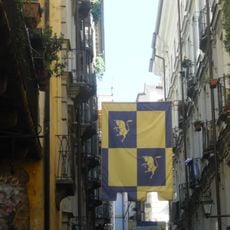
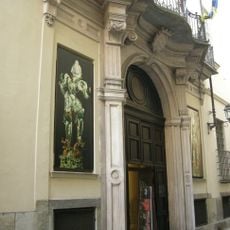
Palazzo di Città, Baroque palace in central Turin, Italy.
The Palazzo di Città is Turin's city hall, a baroque building on Piazza Palazzo di Città. Its two upper floors alternate windows and pilasters, with a central clock structure flanked by two niches. The ground floor has a portico; at the entrance stand mid-19th-century statues of Ferdinando di Savoia, Duke of Genoa, and Eugene of Savoy. Inside, the Cortile d'Onore remains as designed by Francesco Lanfranchi.
The first stone was laid in 1659 by Turin archbishop Giulio Cesare Bergera, in the presence of Duke Carlo Emanuele II and his mother Cristina di Francia, on the site of the medieval city hall. Architect Francesco Lanfranchi followed Emanuele Tesauro's baroque plans, and work was completed in 1663. The inauguration coincided with the duke's wedding to Francesca Maddalena d'Orléans, celebrated with fireworks on the square. In 1799 Jacobins destroyed the Savoy-Orléans coat of arms and its bronze lions.
The council meets in the Sala Rossa, named for its red velvets and damasks; the room was reshaped by Benedetto Alfieri in 1758 and again between 1880 and 1882. Its ceiling paintings are 17th-century works by Giovanni Andrea Casella, and an altorilievo by Giacomo Spalla shows Vittorio Emanuele I on horseback. The Sala dei Marmi, decorated by Lombardi in 1815, is now used mainly for civil weddings.
The palace faces Piazza Palazzo di Città, a short walk from Via Garibaldi and Via Corte d'Appello, the two streets flanking its side wings. The Salone dei Marmi on the first floor is used for civil weddings, while the Sala Rossa hosts council meetings, so room access follows municipal business. The rear courtyard keeps the name Corte del Burro from the old butter market it absorbed.
The square was long a market: the Piazza delle Erbe sold vegetables, while the nearby Piazza del Grano handled cloth and grain. A brick arch called "la volta rossa" separated the two areas, and merchants from Chieri parked their stalls beneath it. The Piazza del Burro, absorbed into the palace in the 18th century, survives as the Corte del Burro.
The community of curious travelers
AroundUs brings together thousands of curated places, local tips, and hidden gems, enriched daily by 92,785 contributors worldwide.