Palazzo Fibbioni, Renaissance palace in L'Aquila, Italy.
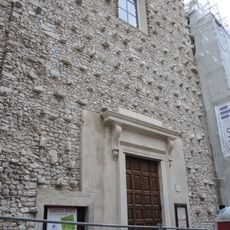
Palazzo Fibbioni stands at the Quattro Cantoni crossing, the centre of L'Aquila's cardo-decumanus grid, and forms a single block with the adjoining Palazzo Lopez. Its two public facades, on via San Bernardino and corso Vittorio Emanuele, are each divided horizontally into three parts; the main one has a rusticated portal from the 16th or 17th century, with classical rectangular openings grouped around it. Inside are wooden ceilings painted by Giovan Paolo Cardone, a pupil of Pompeo Cesura.
Bartolomeo del Secco moved from the Novara province to L'Aquila in the 16th century, where he was nicknamed "Fibbione"; his son Giambattista already lived in the palace in 1578. Damaged by the 1703 earthquake, it was hit again in 2009 and restored between 2012 and August 2014. The last heirs, Teodora and Agnese Fibbioni, set up a foundation in 1899 to manage and protect the building.
The name Fibbioni comes from the nickname «Fibbione» given in L'Aquila to Bertolomeo del Secco, who moved there from the Novara area in the 16th century. The family died out at the end of the 19th century; in 1899 the last heirs, Teodora and Agnese Fibbioni, set up a foundation to manage and protect the building.
The palace stands at the Quattro Cantoni crossing, where Via San Bernardino meets Corso Vittorio Emanuele, so it is reached on foot from the city centre. It housed the municipal offices from 2015 to 2023 and still holds some municipal offices; it is an administrative building, not a museum, so only the public-facing parts are accessible.
The interior features intricately crafted wooden ceilings and paintings by local artists that showcase Renaissance style. These decorative elements reveal how wealthy families decorated their homes with artworks during that period.
The community of curious travelers
AroundUs brings together thousands of curated places, local tips, and hidden gems, enriched daily by 92,786 contributors worldwide.