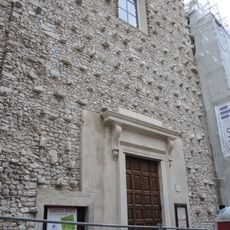
Torre civica, Medieval belfry and clock tower in Piazza Palazzo, L'Aquila, Italy.
The Torre Civica rises at the south-western end of Piazza del Palazzo, joined to Palazzo Margherita but architecturally separate from it. It has a square plan on three and a half levels divided by string-course cornices faced in stone ashlars, and its truncated top now carries a small terrace with an aedicula. The main facade shows, from the bottom, the effigy of Giuseppe Garibaldi placed in 1901, the late 13th-century eagle coat of arms of L'Aquila, the arms of Charles V and of a Spanish captain, and the clock installed at the end of the 19th century. Its present height is about 26-27 metres, against roughly 52 metres originally.
The tower already stood when L'Aquila was definitively founded in 1254, making it one of the city's oldest surviving structures. In 1310 Captain Francesco Di Crescenzo had it rebuilt taller and detached from the Palazzo del Capitano di Giustizia. In 1374 Captain Tommaso degli Albizi installed a public clock, the first in the Kingdom of Naples and the second in Italy after Florence's Palazzo Vecchio and Ferrara's Torre Marchesana.
The tower's bell still rings 99 times at sunset, recalling the 99 castles that founded L'Aquila. The original bells, including one called Reatinella, were melted down by the Spanish in 1545. Each 28 August the Bolla del Perdono is brought out for the opening of the Porta Santa, and the Fuoco del Morrone is lit on the tower around 23 August to start the Perdonanza Celestiniana.
Reconstruction of the tower and Palazzo Margherita began on 4 November 2016, with works planned to last about 500 days. The tower stands at the south-western end of Piazza del Palazzo, the city's municipal seat, and is architecturally separate from the adjoining palazzo. Check access conditions before visiting while restoration is under way.
The lower part of the tower holds the chapel of the Madonna degli Angeli, where condemned prisoners received comfort before their sentence was carried out. It also houses the Bolla del Perdono, a papal document granting plenary indulgence, kept in a reinforced chapel and brought out only on 28 August for the opening of the Holy Door.
The community of curious travelers
AroundUs brings together thousands of curated places, local tips, and hidden gems, enriched daily by 93,119 contributors worldwide.