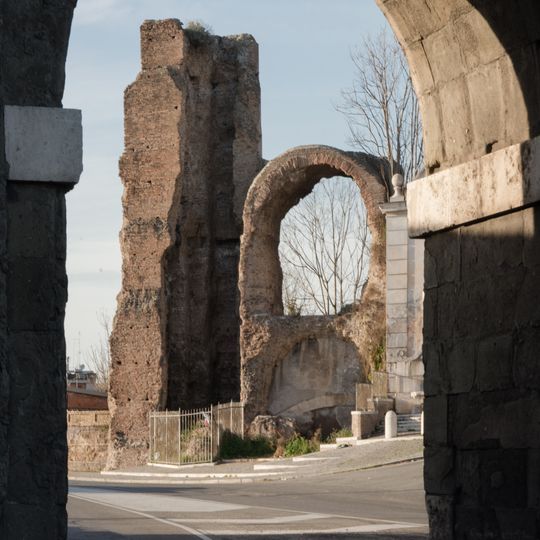
Porta Furba, City gate in Tuscolana district, Rome, Italy.
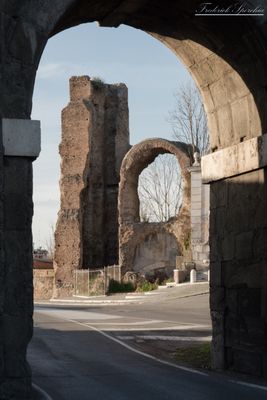
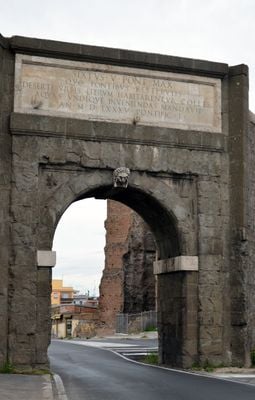
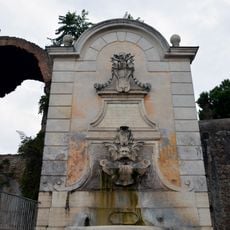
Porta Furba is the arch formed where the Acquedotto Felice crosses the Via Tuscolana in Rome's Tuscolano district. Its vault is clad in blocks of peperino and tufo, while the keystone, the arch line and the inscription frames are travertine; the inscriptions themselves are carved in marble. A weathered grey stone gate with a single arched opening, it carries a plaque with a Latin inscription of Sixtus V and a small carved head at the top centre.
The gate was built in 1585 under Pope Sixtus V and was part of the Aqua Felice aqueduct system that brought water into the city. The construction connects Roman engineering tradition with 16th century urban development.
The name's origin is uncertain: some link it to the Latin fur, a thief, for brigands who robbed travellers at the gate; others to a corruption of formae, the medieval word for aqueducts, as on Eufrosino della Volpaia's 1547 map. The marble inscriptions celebrate the aqueduct's construction.
The gate sits right next to Porta Furba-Quadraro metro station on line A, making it easy to reach. The best time to visit is in the morning when there is less traffic on Via Tuscolana.
The origin of the name is uncertain: one explanation links it to the Latin fur, a thief, referring to brigands who extorted travellers passing through the gate; another traces it to a corruption of formae, the medieval word for aqueducts, as used on Eufrosino della Volpaia's 1547 map.
The community of curious travelers
AroundUs brings together thousands of curated places, local tips, and hidden gems, enriched daily by 92,954 contributors worldwide.