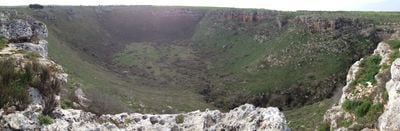
Pulo di Altamura, Karst doline in Altamura, Italy.
Pulo di Altamura is a karst doline on the Murge plateau, about 6 km north-west of Altamura. Its rim measures roughly 1,800 m in perimeter, with diameters over 500 m and a depth of 70–75 m. The northern side is nearly vertical, with crannies and three caves: Grotta del Colombo, Grotta dell'Imbroglio and Grotta dell'Orco.
The formation took shape over millions of years through karst processes, as water slowly dissolved and hollowed the limestone rock. Carmelo Colamonico conducted the first scientific study in 1917, documenting how this geological creation came to be.
The three caves in the northern wall are named Grotta del Colombo, Grotta dell'Imbroglio and Grotta dell'Orco. Domenico Santoro wrote in 1688 that Saint William of Montevergine had lived as a hermit in one of these caves, though his sources are unknown. The northern side, almost vertical, also holds crannies that may have sheltered hominids; Altamura Man was found nearby.
The doline lies about 6 km north of Altamura on the Murge plateau, reached by unpaved tracks; the rim is the easiest place to walk, while the inner slopes are steep and covered in scrub. The three caves — Grotta del Colombo, Grotta dell'Imbroglio and Grotta dell'Orco — open in the near-vertical northern side, so approach them only with proper equipment.
The northern wall, almost vertical, holds three caves: Grotta del Colombo, Grotta dell'Imbroglio and Grotta dell'Orco. Domenico Santoro wrote in 1688 that Saint William of Montevergine had lived as a hermit in one of them, though the primary sources for that claim are unknown.
The community of curious travelers
AroundUs brings together thousands of curated places, local tips, and hidden gems, enriched daily by 94,579 contributors worldwide.