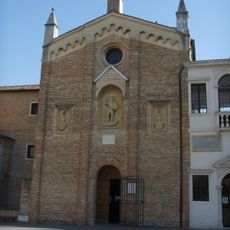
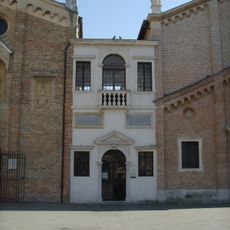
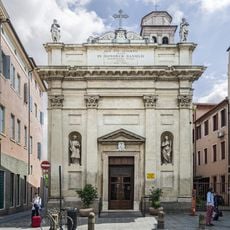
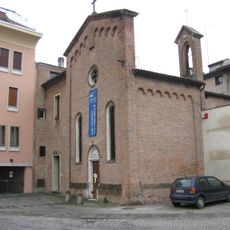
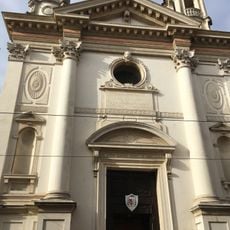
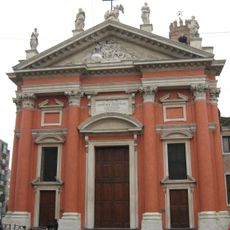
Santuario di San Leopoldo Mandić, Catholic shrine in Santa Croce district, Padua, Italy.
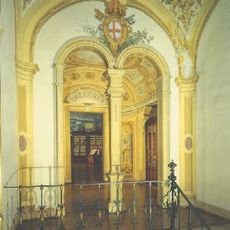
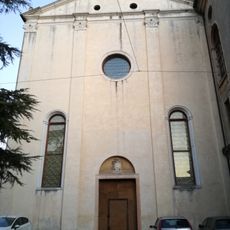
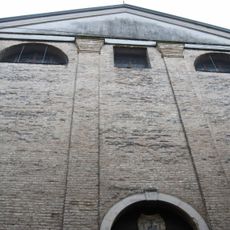
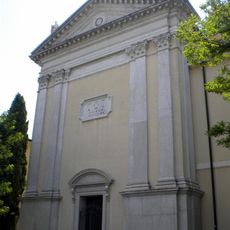
The church of the Transfiguration, now known as the Santuario di San Leopoldo Mandić, stands in Contrà Santa Croce in Padua. It is a single-nave Franciscan-style church rebuilt after the Allied bombing of 14 May 1944 to designs by Giovanni Morassutti and consecrated in 1950. Behind the altar hangs a large wooden crucifix by Luigi Strazzabosco; the 1989 organ by Gastone Leorin was restored and enlarged in 2019.
Capuchin friars reached Padua in 1537 and settled outside the walls; in 1554 they moved into the Santa Croce quarter, taking over the large house and garden of the nuns of Sant'Agata and Santa Cecilia. Their first church, built in 1581, was demolished in 1811 and replaced in 1824-1825. Allied bombing on 14 May 1944 destroyed almost everything; the present church, by architect Giovanni Morassutti, was consecrated in 1950.
The church is now dedicated to Leopold Mandić, a Capuchin friar and priest who heard confessions here and was canonized in 1983. Pilgrims come to the tomb of the saint, placed in a room next to the church beside the small cell where he confessed.
The church stands on Piazzale Santa Croce in the Santa Croce district, a short walk from Padua's historic centre. The tomb of Saint Leopold Mandić lies in a room adjoining the church, next to the small cell where he heard confessions, so pilgrims and other visitors enter the same area. The Capuchin friars still serve the church.
The only structure said to have survived the Allied air raid of 14 May 1944 was Leopold Mandić's original confessional; the saint had died in 1942, before the bombing. The rebuilt church, consecrated in 1950 to Giovanni Morassutti's design, keeps his tomb in a room next to the little cell where he heard confessions.
The community of curious travelers
AroundUs brings together thousands of curated places, local tips, and hidden gems, enriched daily by 92,854 contributors worldwide.