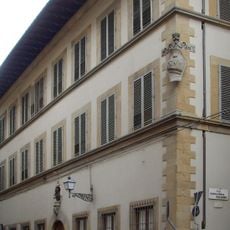
Poste in via Pietrapiana in Florence, Brutalist palace in Via Pietrapiana, Florence, Italy.
The Poste in via Pietrapiana occupies a block between via Pietrapiana, via Verdi, via dei Pepi and via dell'Ulivo. Giovanni Michelucci's building, finished in 1967, sets three tall C-shaped blocks around a courtyard, with the public hall and staff flats in low volumes. A San Giuliano limestone base juts out at the corner entrance; above, three floors of exposed reinforced concrete follow its line. Inside, a pillared internal street runs parallel to via Pietrapiana into the double-height public hall, roofed by a row of plastered concrete paraboloids.
The lot between via Pietrapiana, via Verdi, via dei Pepi and via dell'Ulivo was cleared in the second half of the 1930s by Fascist demolitions, removing the Teatro Alfieri and the Farmacia del Canto alle Rondini. Giovanni Michelucci received the commission and produced several project versions between 1959 and 1964; the building was finished in early 1967. New technical volumes were added on the top floor in the early 1970s.
The site once held the Teatro Alfieri and the Farmacia del Canto alle Rondini, cleared by Fascist-era demolitions in the 1930s before Michelucci's building rose. Inside, the public hall is covered by a sequence of plastered reinforced-concrete paraboloids, and a covered gallery runs parallel to Via Pietrapiana like an internal street between heavy vertical pillars.
The building occupies the block between Via Pietrapiana, Via Verdi, Via dei Pepi and Via dell'Ulivo, on the edge of Santa Croce. The public post office is on the ground floor, reached through a gallery that runs parallel to Via Pietrapiana between large pillars. The corner entrance on the two main streets sits under a projecting plinth; the duplex staff flats are reached by the exposed two-ramp stair on the Via Verdi side.
The building stands in sharp contrast to the Renaissance structures that characterize the rest of Florence and shows a different architectural approach. This unexpected presence of modern brutalist form makes it a notable example of the city's 20th-century development.
The community of curious travelers
AroundUs brings together thousands of curated places, local tips, and hidden gems, enriched daily by 95,042 contributors worldwide.