Waldensian Church, Protestant church building in Turin, Italy
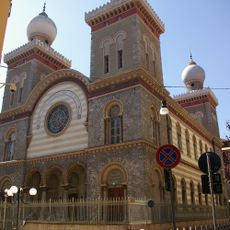
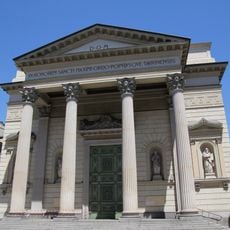
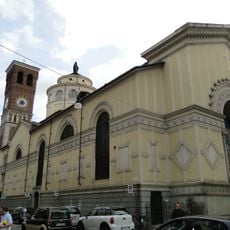
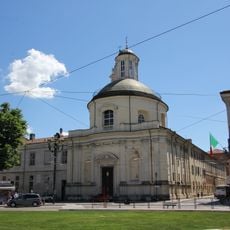
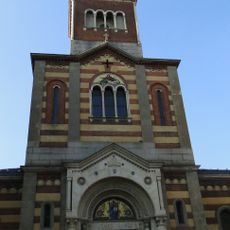
The Waldensian Church (Tempio Valdese) stands at corso Vittorio Emanuele II 23, built 1851–1853 to Luigi Formento's design in an eclectic style: neo-Gothic towers and spires, a neo-Romanesque portal and windows, neo-Renaissance touches inside. The facade is split by a sculpted cornice, flanked by two slender octagonal bell towers with cusps; below, a splayed portal with a semicircular lunette inscribed "Credi nel Signor Gesù Cristo e sarai salvato" (Acts 16:31), above a seven-light polifora and a circular rose window. Three naves of round arches on Corinthian columns, cross vaults, a semicircular apse with a neo-Gothic wooden pulpit.
Until 1848 Waldensians could not reside in Turin or hold worship there; the few present attended services in the chapel of the Prussian embassy. The 1848 letters patent of King Charles Albert changed their legal status, and in 1849 the Turin evangelical congregation was formally joined to the Church of the Valleys. With funds from banker Giuseppe Malan for the land and the initiative of English colonel Charles John Beckwith, Luigi Formento's design was built between 1851 and 1853 and inaugurated on 15 December 1853 before the ambassadors of Prussia, England, the Netherlands and Switzerland.
The temple's name comes from the Waldensians, the pre-Reformation movement of the Alpine valleys; the Turin congregation was officially attached to the Church of the Valleys in 1849. Services were held in Italian and French in the 19th century, when the building also housed a Waldensian school and nursery and an Anglican chapel. On 22 June 2015 Pope Francis visited, the first pope to enter a Waldensian church.
The temple stands at corso Vittorio Emanuele II 23, a short walk from Porta Nuova station and next to the 1884 synagogue in the same street. The entrance is on the street front, under the sculpted cornice and the portal inscribed with Acts 16:31. The Pinchi organ of 1996 sits under the last arch between the central nave and the left aisle.
The Pinchi organ, opus 412, built in 1996 beneath the last arch between the central nave and the left aisle, uses Werckmeister III tuning with A at 415 Hz; three of its stops are set to equal temperament at 440 Hz so the instrument can accompany modern instruments such as a guitar.
The community of curious travelers
AroundUs brings together thousands of curated places, local tips, and hidden gems, enriched daily by 92,788 contributors worldwide.