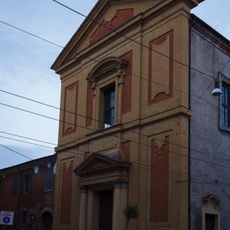
Synagogue of Modena, Jewish temple in Modena, Italy
The Synagogue of Modena, built 1869–1873 to a design by Ludovico Maglietta, stands on Piazza Mazzini with its entrance on Via Coltellini, oriented east toward Jerusalem. The rectangular prayer hall has the aron and tevah at its converging end, twelve columns supporting the women's gallery, and an elliptical dome painted blue with stars. All decoration is non-figurative, as Jewish law requires.
The building was constructed in 1873 following the community's liberation from ghetto restrictions, marking a major turning point in their history. This new synagogue represents the growth and establishment of the Jewish community in the city during the late 1800s.
The aron holds the Torah scrolls beneath a parokhet bearing the Hebrew phrase "Yehovah hu ha-Eloim", with the Tablets of the Ten Commandments above it. Twelve columns supporting the women's gallery likely stand for the twelve tribes of Israel, and palm motifs on the facade are a biblical reference. Silver ornaments come largely from 18th-century Venetian and 19th-century Modena workshops.
The synagogue stands in Piazza Mazzini, a few dozen metres from the town hall, with its entrance on Via Coltellini because the building is oriented east toward Jerusalem. Since the 2003 car bombing outside the building, it has been under round-the-clock surveillance by law enforcement, so visits are arranged with the Jewish Community rather than made on impulse.
The twin monumental facades became fully visible only when neighboring structures were demolished in the early 1900s to create Piazza Mazzini. This urban transformation completely reshaped how people view and approach the building today.
The community of curious travelers
AroundUs brings together thousands of curated places, local tips, and hidden gems, enriched daily by 94,641 contributors worldwide.