Mascagni Terrace, Seafront terrace in Livorno, Italy
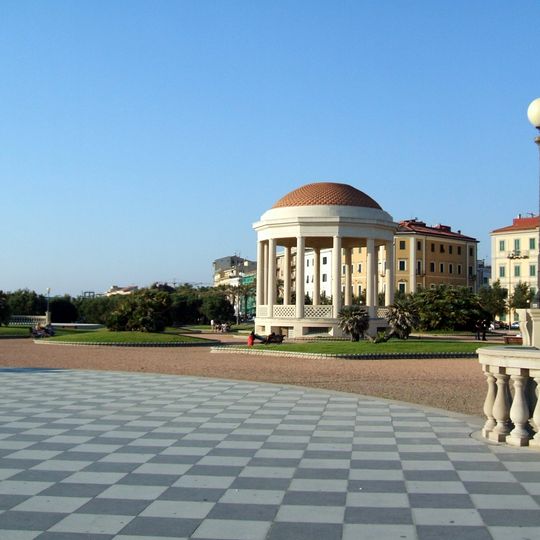
Mascagni Terrace is a seaside promenade in Livorno with a distinctive checkered floor made of black and white tiles arranged in a geometric pattern. The space is lined with a long balustrade supported by many columns and faces directly toward the sea.
The terrace's core was built from 1925 to a design by engineer Enrico Salvais with Luigi Pastore, on the site of the Forte dei Cavalleggeri, a coastal fort demolished in 1872. After World War II it was extended north over rubble from the bombed city centre, taking its curved shape, and was then named after Livorno-born composer Pietro Mascagni.
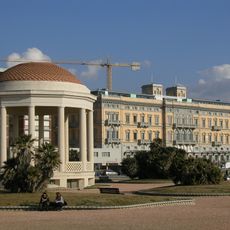
The terrace is named after Pietro Mascagni, the Livorno-born composer of Cavalleria rusticana. Its earlier name honoured Costanzo Ciano, a local Fascist leader who had no hand in building it. The music pavilion donated by consul Pedro Bossio was inaugurated on 27 September 1931 with the band of La Spezia, destroyed in the war and rebuilt in the 1990s.
The terrace is easy to reach from the seafront and offers many benches where you can sit and watch the water. The white tiles reflect sunlight strongly, so visiting on a sunny day means the ground will be bright and glare-prone.
The checkerboard pattern created by thousands of tiles produces shifting visual effects depending on the angle of sunlight and time of day. This means the floor appears different throughout the day as light and shadow play across the checkered surface.
The community of curious travelers
AroundUs brings together thousands of curated places, local tips, and hidden gems, enriched daily by 94,670 contributors worldwide.