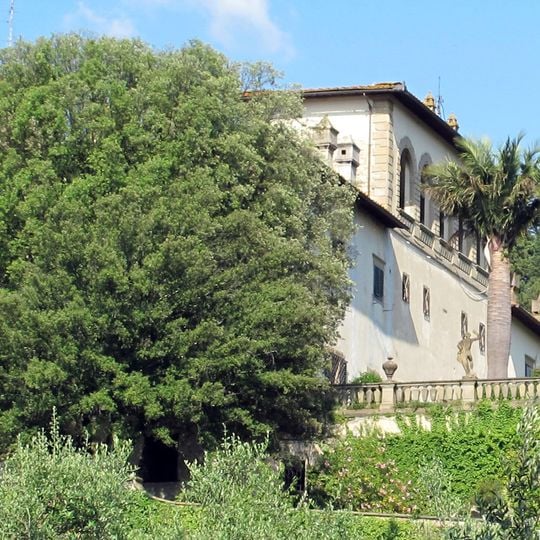
Villa Palmieri, Fiesole, Renaissance villa in Fiesole, Italy
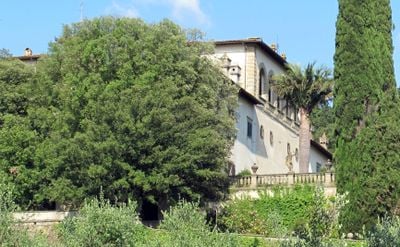
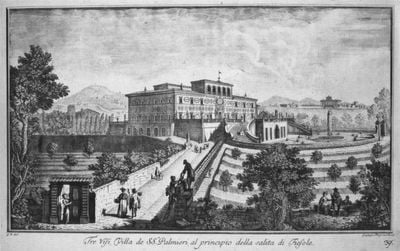
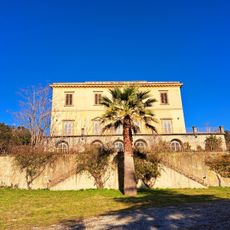
Villa Palmieri is a patrician villa on the slopes below Piazza San Domenico in Fiesole, its light stucco facade rising above a stone balustrade terrace with arched openings above rectangular windows. The oldest surviving feature is the oval lemon garden, where terracotta pots of citrus are set in warm weather around a circular basin framed by clipped low boxwood hedges, following an eighteenth-century engraving by Giuseppe Zocchi.
The villa existed by the late 14th century as a possession of the Fini, who sold it in 1454 to the humanist scholar Matteo di Marco Palmieri, whose name it bears. In 1697 Palmiero Palmieri rebuilt the gardens with a south-facing terrace, a five-bay arcaded loggia and paired curved stairs down to the lemon garden. In 1760 it passed to the 3rd Earl Cowper, and in 1873 to James Ludovic Lindsay, 26th Earl of Crawford, who laid out English-style parkland with exotic trees, the Fountain of Three Faces and a neo-Baroque chapel.
Boccaccio set the frame story of the Decameron, told by ten young people fleeing the Black Death in Florence, in a garden near Fiesole; his description is too general to identify one villa securely. The slopes below Piazza San Domenico hold several 14th-century candidates, including the secondary villa in the park, now called Villa Benelli, and Villa Schifanoia, once part of the estate.
The lemon garden sits on the lower level, reached by the symmetrically paired curved stairs (a tenaglia) from the south-facing terrace with its five-bay arcaded loggia. The upper terrace rests on the vaults of the limonaia, glazed in the nineteenth century, where the lemon trees overwinter against hard frost. The grounds lie on the slopes below Piazza San Domenico in Fiesole, overlooking Florence.
Labels attached to trees in the lemon garden record Queen Victoria's three visits to the villa, in 1888, 1893 and 1894. The garden itself follows an eighteenth-century engraving by Giuseppe Zocchi, and the upper terrace rests on the vaults of the limonaia, glazed in the nineteenth century to shelter the lemon trees from hard frost.
The community of curious travelers
AroundUs brings together thousands of curated places, local tips, and hidden gems, enriched daily by 93,995 contributors worldwide.