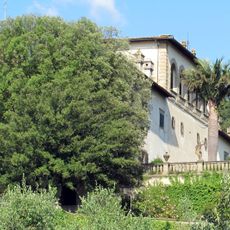
Villa Salviati, Renaissance villa in Florentine hills, Italy
Villa Salviati is a Renaissance residence in the hills surrounding Florence with ornately decorated facades and period architecture. The grounds include formal gardens laid out in geometric patterns, decorated with sculptures and terracotta pieces positioned throughout.
The villa was built in the 15th century as a summer home for the Salviati family and stayed in their hands until the 17th century. Later it changed purpose and eventually became an institutional and academic space.
Since 2000 the complex has housed the Historical Archives of the European Union, opened on 17 December 2009 by President Giorgio Napolitano. Among the holdings are the personal papers of founders such as Alcide De Gasperi, Paul-Henri Spaak, Altiero Spinelli and Ernesto Rossi. The villa is also known as del Ponte alla Badia, after a suppressed Cistercian convent linked to it by an underground gallery.
The complex has three entrances: on via Salviati with an iron gate, on via Faentina at number 261, where a suspended passage crosses the railway, and along the road of the same name near via Bolognese. The cellars, reached by a hidden staircase, are not open to the public. The south front is approached along a cypress avenue.
The cellars, reached by a hidden staircase, are closed to visitors; legend holds that the gold ingots of Pisan charcoal burners are kept there. The villa is also linked by an underground gallery to Villa Emilia, a Cistercian convent suppressed in 1453, hence the name del Ponte alla Badia.
The community of curious travelers
AroundUs brings together thousands of curated places, local tips, and hidden gems, enriched daily by 94,586 contributors worldwide.