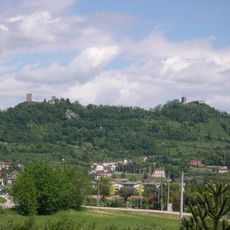
Villa Trissino Marzotto, 18th-century Venetian villa in Trissino, Italy
Villa Trissino Marzotto is a monumental complex in Trissino, province of Vicenza, made up of an upper villa on the hill and a lower villa below, linked by late-Baroque entrances, a lemon house, an octagonal fountain, a cavallerizza and over one hundred statues in the park. The lower villa, rebuilt after a lightning fire in 1841, has four corner towers and ivy giving it the look of a castle ruin.
The estate was built on the site of a medieval fortress and underwent major reconstruction between 1718 and 1722 under architect Francesco Muttoni for the Trissino family. This transformation created one of the region's significant examples of early 18th-century Venetian design.
The villa holds a complete set of six tapestries, the Four Seasons cycle plus two rural scenes, woven around 1550 by Willem de Pannemaker's Brussels workshop after designs by Giulio Romano. Frescoes by Tommaso Porta and his son Andrea decorate a corridor, the red-fireplace sitting room and the central hall.
The complex is entered from Piazza Giangiorgio Trissino through a 1593 arch with two Tuscan semicolumns and a pediment. Paths and covered passages run between the upper villa on the hilltop and the lower villa in the valley, so allow time for walking between levels. The octagonal fishpond, terraces and double staircase to the Neptune fountain are outdoors.
The upper villa's entrance arch on Piazza Giangiorgio Trissino dates to 1593, with two Tuscan half-columns carrying a pediment topped by three acroteria. The garden gate ordered by Marcantonio Trissino in 1693 mixes floral motifs and pinnacles on the pillars that recall oriental forms.
The community of curious travelers
AroundUs brings together thousands of curated places, local tips, and hidden gems, enriched daily by 94,579 contributors worldwide.