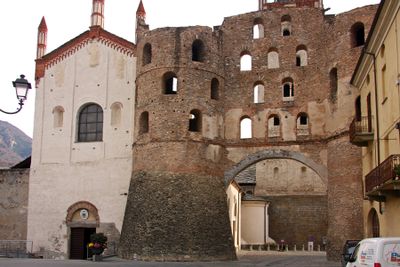
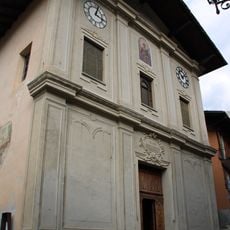
Porte de Savoie, Roman city gate in Susa, Italy.
Porte de Savoie is a Roman city gate in Susa that served as the primary entrance to the settlement during the early medieval period. Its surface displays distinctive fish-bone patterns and round windows arranged in an offset configuration along its walls.
The gate was built during the 3rd to 4th century AD when Rome controlled the Alpine region and remains the only preserved entrance from the original Roman walls. It marks a crucial point in Susa's development as a fortified settlement guarding passage toward the mountains.
The structure takes its name from the House of Savoy and is also called Porta del Paradiso because of its nearness to San Giusto Cathedral. Visitors notice how this dual naming reflects the bond between the monument and the city's main religious buildings.
The monument is free to visit and located at Piazza Savoia where you can view the Roman structure at your own pace. From this point, you can easily walk to other parts of the old town and explore various pathways through the historic center.
The gate was originally designed as a control point for commerce and movement across the Alpine passes, providing strategic oversight of a crucial access route. This combination of defensive features and its role as a traffic junction makes it an unusual example of Roman frontier architecture.
The community of curious travelers
AroundUs brings together thousands of curated places, local tips, and hidden gems, enriched daily by 91,419 contributors worldwide.