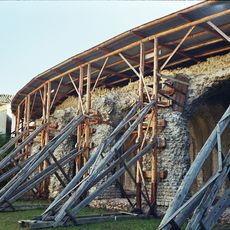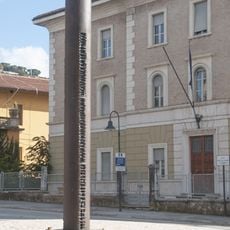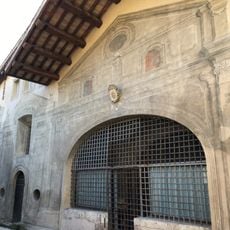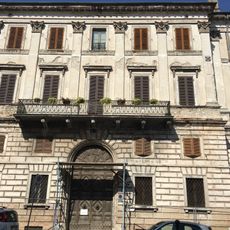
Ponte Sanguinario, Roman bridge ruins in Spoleto, Italy.
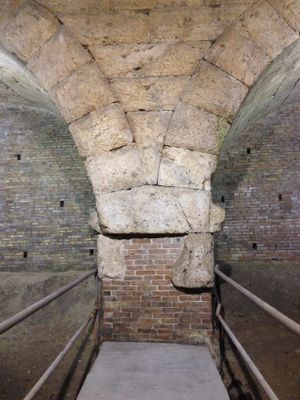
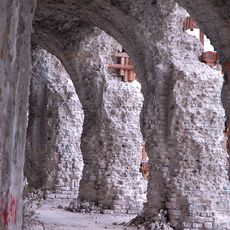
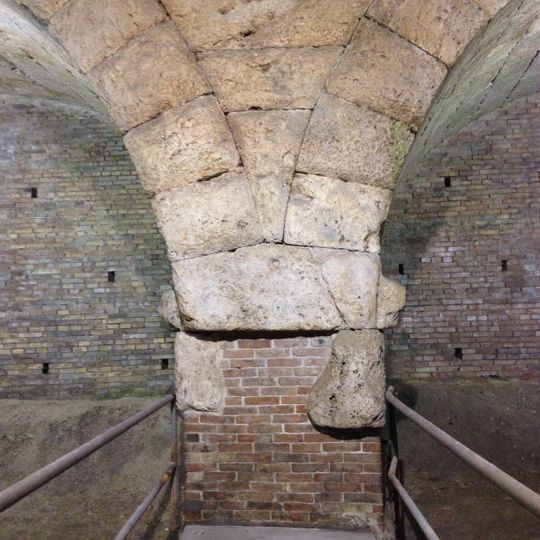
Ponte Sanguinario is a Roman bridge made from travertine stone that stretches 24 meters long and rises 8.07 meters high. Three semicircular arches form its main structure, though restoration work in recent decades has affected its original appearance.
The bridge may have been built under Augustus around 27 BC when he restored the bridges of the Via Flaminia, or earlier when the road opened around 500 BC. It carried the Via Flaminia over the Tessino and also served the diverticulum and the via Pedemontana to Foligno. The river shifted north and was redirected under the bridge at the end of the 13th century; later floods buried it until 1817, when public works under the restored Papal State uncovered it. Excavation concluded in 1820, before Emperor Francis II's visit on 29 December 1820.
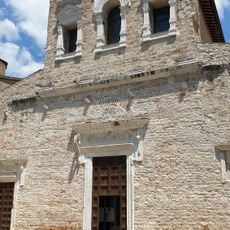
The bridge carries stories about Saint Ponziano, Spoleto's patron saint, whose execution at this site has shaped how local people understand this ancient structure. These religious connections give the place deeper meaning for residents and visitors alike.
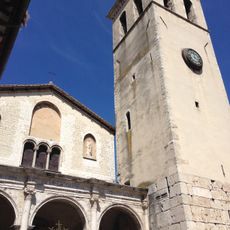
You can reach the underground sections by descending a short iron-railed staircase located near Piazza della Vittoria. The site sits close to Porta Leonina and the San Gregorio Maggiore Basilica, making it easy to combine with other visits in the area.
The Ponte Sanguinario is not fully excavated: only two of its three arches are visible, the third still buried under the embankment that carries the road. The bridge was never completely brought back to light, even after the access passage was restored in 1993.
The community of curious travelers
AroundUs brings together thousands of curated places, local tips, and hidden gems, enriched daily by 92,904 contributors worldwide.