Santa Maria Rossa in Crescenzago Church, Romanesque church in Crescenzago, Milan, Italy
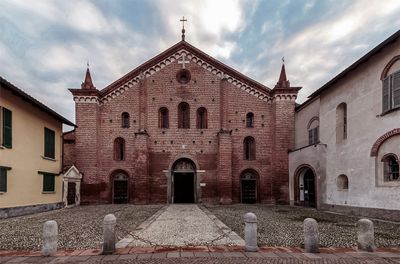
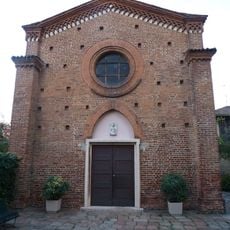
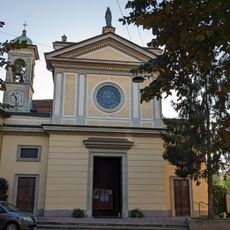
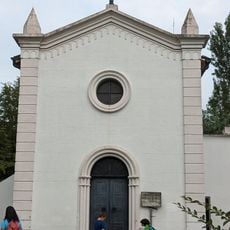
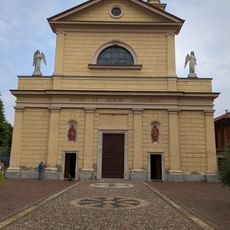
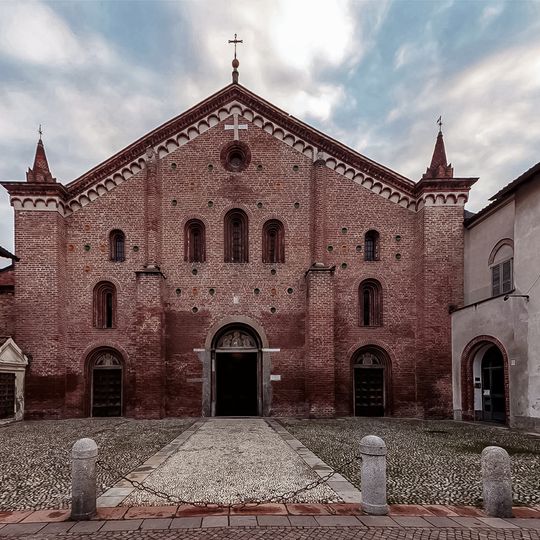
Santa Maria Rossa in Crescenzago is a basilica-plan church without a clerestory, with three naves and three semicircular apses, built in Lombard Romanesque style with a gabled roof. The exterior walls are laid in courses of large bricks; the facade has corner pilasters topped by brick pinnacles and a band of small arches on a white plaster background, a motif repeated on the apse. The central portal is stone, the two side portals are brick, and the facade is decorated with groups of yellow and green majolica plates.
Archbishop Robaldo founded a canonical house around 1140 on the site of an earlier chapel to the Virgin; a 1923 plaque dates the surviving masonry fragments to 935. His successor Umberto I da Pirovano took the Augustinian canons under his protection, and a dispute with the provost of Rosate was settled by Pope Lucius III in 1182. In 1772 Cardinal Giuseppe Pozzobonelli suppressed the canonica and it became a parish church.
The church displays original Romanesque frescoes on its walls depicting the Agnus Dei and angels in prayer, which continue to define the appearance of the central nave. These images reflect the artistic traditions of the medieval period and remain central to how people experience the interior.
The church follows the Ambrosian Rite with regular mass services, including special ceremonies during the Christmas season starting in mid-November. Visitors should check opening times before arriving and be respectful of worship activities and prayer periods while inside.
Matteo Visconti died at the canonica on 24 June 1322, and legend holds that his tomb lies hidden in the church, never found. In fact his body was probably moved decades later to Sant'Eustorgio in Milan, where many of his relatives were buried.
The community of curious travelers
AroundUs brings together thousands of curated places, local tips, and hidden gems, enriched daily by 93,578 contributors worldwide.