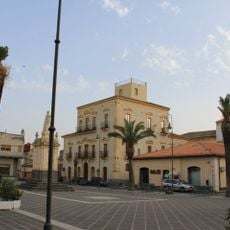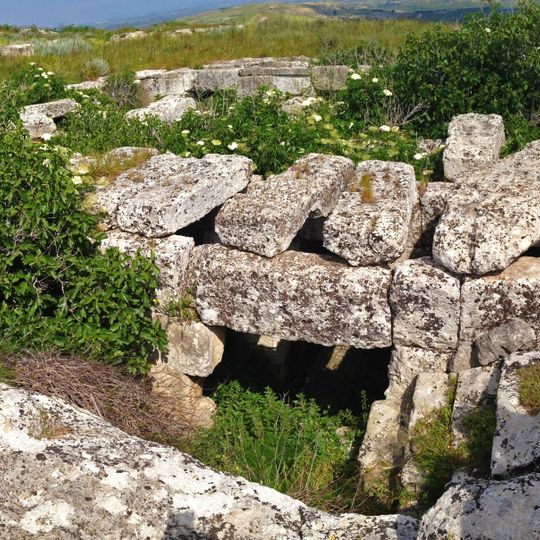
Colonne di San Basilio, Archaeological site and Greek era structure in Lentini, Italy.
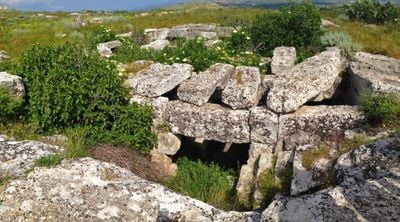
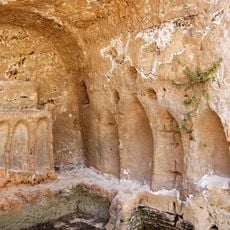
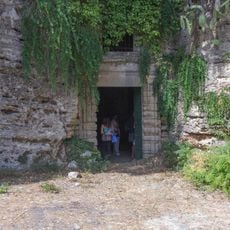
Colonne di San Basilio is a rock-cut structure on Monte San Basilio, in the territory of Lentini, measuring 18 by 16 metres and carved into limestone. Thirty-two columns, some still standing after partial collapse, were cut to support stone slabs. A staircase at the right corner leads down into the square-plan space, where traces of frescoes remain on some columns.
The summit of Monte San Basilio shows postholes of a hut attributed to the Castelluccio culture, the earliest trace of occupation. Paolo Orsi first studied the rock-cut structure and proposed it served as a cistern for soldiers in the Greek fortified area, whose walls remain visible around the mountain. The Byzantines later converted it into a church, leaving faint, illegible frescoes on some columns. A granary function has also been suggested, and the site is sometimes linked to the Brikinnai named by Thucydides, without proof.
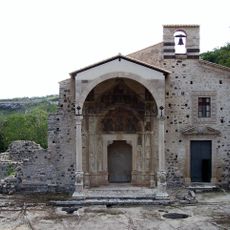
The name comes from the mountain, not from a saint's church: Byzantine worshippers of Saint Basil celebrated mass inside the structure, as Jean Houël recorded in 1777, and left fresco traces on the columns that are no longer legible. A small temple of Demeter and Kore stands in the surrounding area.
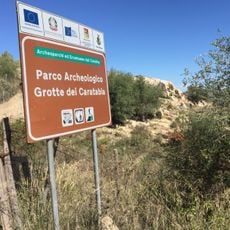
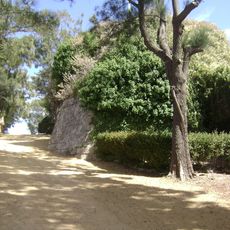
The site lies on private land and is not marked by tourist signs, so access is not guaranteed and no protection or safety measures exist. Dense vegetation inside hinders inspection, and some beams risk collapse. Traces of illegal excavation are visible across the mountain; keep to open ground and watch your footing.
Archaeologist Paolo Orsi discovered that the columns originally supported stone slabs and were part of a water system serving military fortifications. This function remained unknown for a long time and makes the site valuable for understanding ancient infrastructure.
The community of curious travelers
AroundUs brings together thousands of curated places, local tips, and hidden gems, enriched daily by 94,545 contributors worldwide.