Abbazia di San Giuliano, Romanesque monastery on a hillside near Monteluco, Spoleto, Italy.
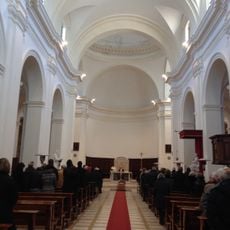
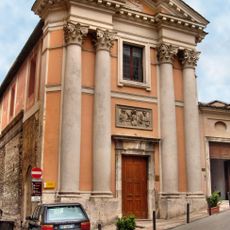
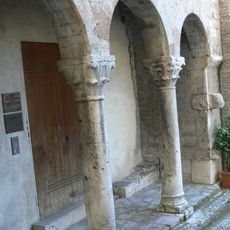
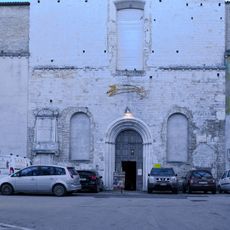
Abbazia di San Giuliano stands at the 5.3 km mark of the road climbing from Spoleto to Monteluco, on a hill at 628 m. Its facade lost its upper section, probably once gabled like Sant'Eufemia, and is pierced by a large trifora with superimposed arches. The round-arched portal reuses early Christian sculptures: palmettes, imbricated scales, trefoils, two doves, an ox, a panther, a peacock and a centaur. Inside, three low naves are divided by squat dressed-stone columns with cylindrical capitals.
The monastic complex dates to the 12th century, but its origin lies in the hermit movement on Monteluco. Around 528 the Syrian Isacco, fleeing the persecution of Emperor Anastasius, settled there, and a virgin named Gregoria gave him land on the hill for a monastery and a church dedicated to Saint Julian of Tebe. Two letters of Pope Pelagius I to the bishop of Spoleto show the monastery already existed by the mid-6th century.
The church is dedicated to Saint Julian of Tebe, and the site was founded after the virgin Gregoria gave Isacco land on the hill for a monastery and church. The monks considered most holy, including Isacco himself, were buried inside; his sarcophagus remained here after the Lateran Canons moved his body to Sant'Ansano in the city.
The abbey stands at kilometre 5.3 of the road climbing from Spoleto to Monteluco, at 628 metres. As of May 2014 it is consecrated but unattended and considered unsafe, so it is not accessible; it opened to the public only for two days during the 2015 FAI spring days, with guided visits.
Archaeological excavations in 2004 uncovered three underground chambers that served as ossuaries from the post-Renaissance period. These hidden spaces held burials and reveal a lesser-known aspect of monastic practices from that era.
The community of curious travelers
AroundUs brings together thousands of curated places, local tips, and hidden gems, enriched daily by 94,459 contributors worldwide.