Santa Maria delle Grazie, minor basilica in Pavia, Italy
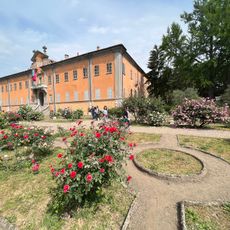
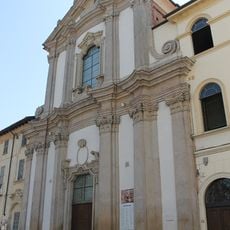
Santa Maria delle Grazie is a Baroque church in Pavia with an unfinished, unclad facade; plans to link it to the city by a large portico were never carried out. Its single-hall interior is divided by 34 granite columns joined by stucco bands, above which the vaulted roof rises. The presbytery and nave hold frescoes by the Fiammenghini brothers (1629–1636), and the triumphal arch a large fresco by the Montalto (1641).
A shrine to the Madonna stood here from 1578; after the reported healing of Agostino Rattazzi, Bishop Giovan Battista Biglia had the church built from 1609 outside Porta Santa Giustina, along the Via Francigena. A Discalced Carmelite convent with a large cloister followed in 1627. Suppressed in 1799, the church became a stable and then a saltpetre works; Bishop Luigi Tosi saved it from demolition and reopened it for worship in 1824. The Salesians took charge in 1897, it became a parish in 1942 and a minor basilica in 1995.
The church serves as an important religious landmark for Pavia's community and reflects a long tradition of devotion through its decorations and artwork. The depictions of saints like Teresa of Avila and Augustine, along with images of prophets and cherubs, speak to a spirituality that deeply moved the faithful over centuries.
The church is located outside the city center along an ancient pilgrim route and is accessible on foot, with parking available nearby for visitors with cars. It is recommended to visit during opening hours and respect moments of prayer and silence to preserve the spiritual nature of the space.
The miraculous 1578 shrine Madonna and Child, linked to the healing of Agostino Rattazzi, survives inside the church as a 16th-century fresco in the second chapel left of the altar. The unfinished facade was meant to be joined to the city by a large portico that was never built.
The community of curious travelers
AroundUs brings together thousands of curated places, local tips, and hidden gems, enriched daily by 94,625 contributors worldwide.