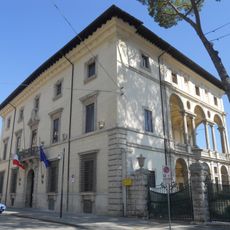
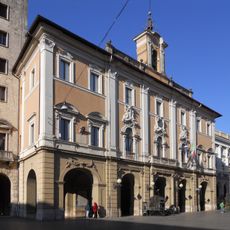
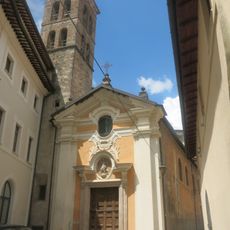
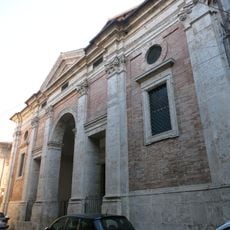
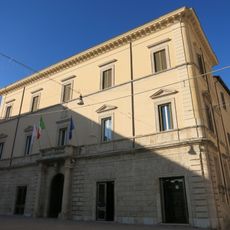
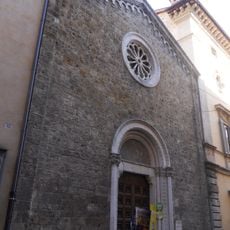
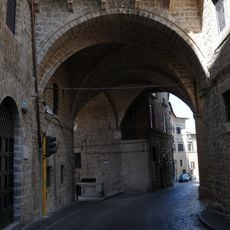
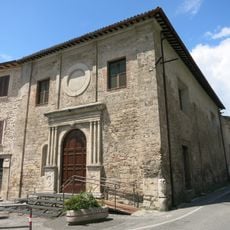
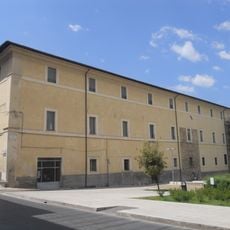
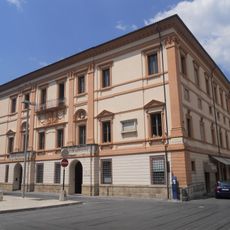
Palazzo Comunale, Neoclassical palace in Piazza Vittorio Emanuele II, Rieti, Italy.
Palazzo Comunale is the town hall and civic museum of Rieti, facing Piazza Vittorio Emanuele II. Its Neoclassical facade by Filippo Brioni (1748–1752) fronts a building that also carries a 20th-century eclectic wing by Cesare Bazzani, Liberty-style interiors by Antonino Calcagnadoro and, beside it, the rationalist civic tower designed by Giuseppe Battistrada. On the eastern side, 13th-century travertine masonry survives, with two fish-shaped reliefs and traces of walled-up windows.
The palace's core was built in the second half of the 13th century as the seat of the priors of the free commune of Rieti, in travertine blocks. It absorbed neighbouring houses at the end of the 15th century, and around 1563 Vignola designed an enlargement of the eastern side, only partly executed. The facade was rebuilt between 1748 and 1752 by Filippo Brioni, and after the 1898 earthquake Cesare Bazzani directed repairs from 1909, adding the ground-floor portico.
The palace interior displays Liberty style decorations created by artist Antonino Calcagnadoro, reflecting artistic trends of the early 20th century. These ornaments shape how the rooms feel and show how the space was designed during that time.
The palace sits on a central plaza in Rieti and is easily accessible on foot when exploring the city center. The best time to visit the Civic Museum is in the morning when the rooms are less crowded and the collections are easier to view.
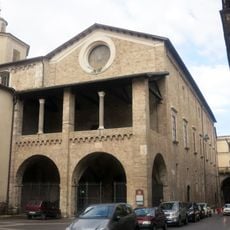
On the eastern side, the 13th-century travertine masonry survives, with a blocked bifora, a walled-up window and two reliefs carved in the shape of fish. The rationalist civic tower designed by Giuseppe Battistrada replaced the old Croce Bianca hotel, demolished in 1935; construction began in 1939.
The community of curious travelers
AroundUs brings together thousands of curated places, local tips, and hidden gems, enriched daily by 93,402 contributors worldwide.