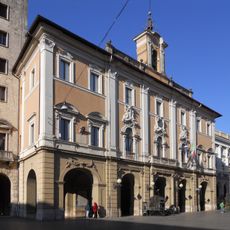
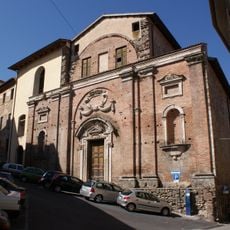
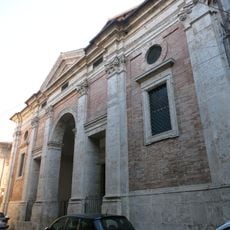
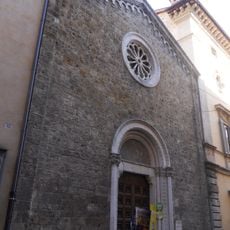
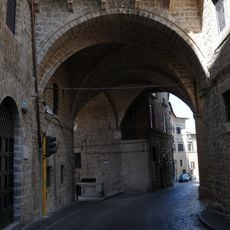
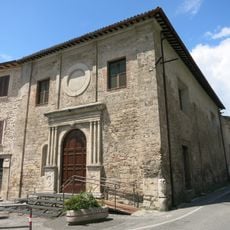
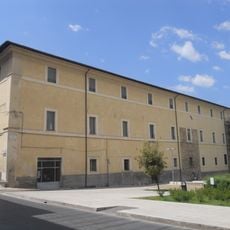
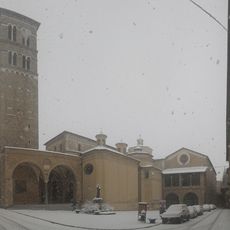
Walls in Rieti, Medieval fortification walls in Rieti, Italy.
The Walls in Rieti consist of a medieval circuit about 1,800 metres long, built from 1252 to around 1320 to close the city's undefended north side. It runs east-west and joins the Velino river at its eastern end and the former Fiume de' Nobili canal at its western end. Traces of the earlier Roman wall, built after 290 BC, survive as reused travertine blocks, for example in the Hotel Miramonti and the church of Sant'Antonio Abate.
Construction of these fortifications began in the early 1200s as the city sought to strengthen its defenses against external threats. Successive generations maintained and reinforced sections of the walls, allowing the structure to remain functional for hundreds of years.
The medieval walls were begun in 1252 and finished around 1320, paid for partly by papal subsidies, and five popes stayed in Rieti during that century. The gates along the circuit carry names still used locally, such as Porta Cordale, the first gate on the right bank of the Velino, walled up centuries ago. The 1979 earthquake brought down merlons in several places, and restoration began in 1980.
The medieval walls run about 1,800 metres east to west, closing the city's north side where it lacks natural defences; the other sides relied on the Velino river and the Fiume de' Nobili canal. The circuit of walls and water covered roughly 4.1 km and enclosed about 630,000 m². The 1979 earthquake brought down merlature in several places, and restoration began in 1980.
At certain points, the walls display visible layers where newer repairs sit on top of earlier construction, revealing how different generations reinforced the same structure. Most visitors walk past these patched sections without realizing they are looking at centuries of maintenance and rebuilding efforts.
The community of curious travelers
AroundUs brings together thousands of curated places, local tips, and hidden gems, enriched daily by 92,885 contributors worldwide.