Santa Maria della Vittoria, Medieval church building in Gubbio, Italy
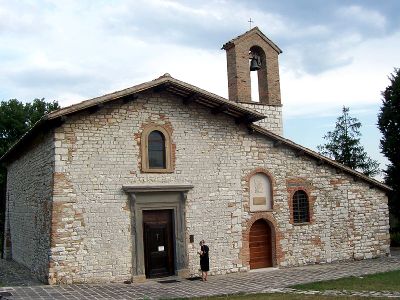
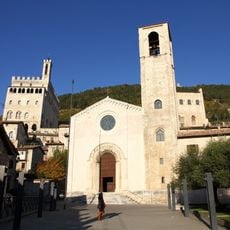
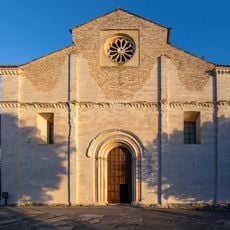
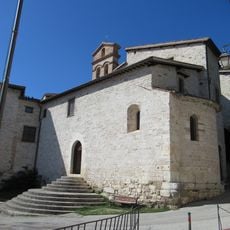
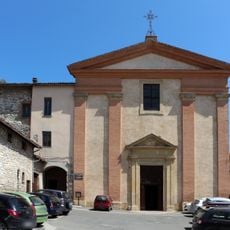
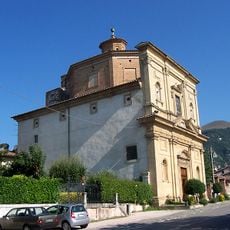
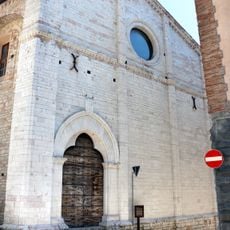
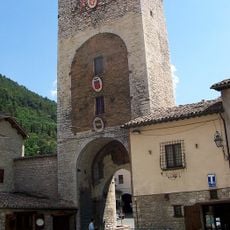
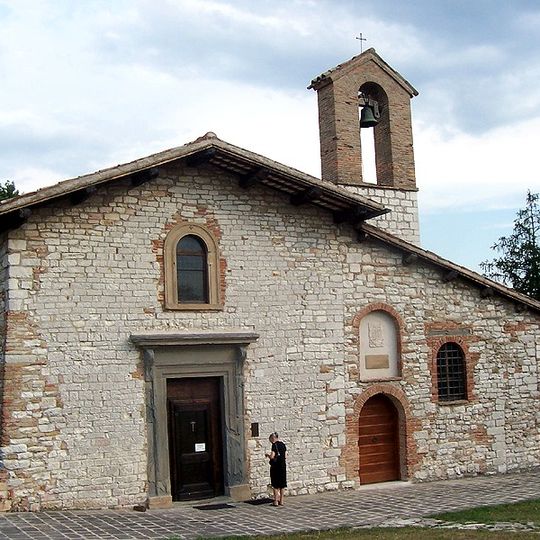
Santa Maria della Vittoria is a small stone church in Gubbio. Its gabled facade is built of irregular light-grey stone blocks with reddish brick accents around the openings: a central wooden door with a rectangular grey stone frame, a round-arched brick-framed window above it, and to the right a second smaller arched door and window. A square stone bell tower with two arched openings, a visible bell and a small cross rises above the right section. Inside, the single nave has a slightly raised presbytery and a vault painted with 16th-century frescoes attributed to Benedetto Nucci.
Popular tradition dates the church's origin to 853, but the building is documented from the 13th century: in 1213 the Benedictines entrusted it to St Francis, who made it the first Franciscan convent in Gubbio. Around 1241 the friars moved to San Francesco in the town and the church passed to the Poor Clares, who numbered 26 by about 1364. In 1538 the nuns ceded it to the lay Company of Santa Maria della Vittorina; after 19th-century suppressions it returned to the Franciscans in 1948 and was reconsecrated in 1957.
The name Vittorina refers to a small victory, and the church is also called the Porziuncola eugubina after the Portiuncula. In 1538 the nuns handed the building to the lay Company of Santa Maria della Vittorina. Outside, a 1973 bronze bas-relief by Farpi Vignoli shows Francis and the wolf.
The church stands just outside Gubbio's historic centre, on the site linked to the wolf encounter. The 16th-century portal in pietra serena opens onto a single nave whose vault is covered with 16th-century frescoes attributed to Benedetto Nucci. Outside, look for the bronze bas-relief of Francis and the wolf by Farpi Vignoli (1973) and a second bronze group by Francesco Scalici (2002).
Outside the church are two bronze works about the Wolf of Gubbio: a bas-relief of the encounter, made by Farpi Vignoli in 1973, and a standing figure of Francis with the wolf, by Francesco Scalici, added in 2002. A stone slab on the blind window reads "Qui Francesco placò la perniciosa Lupa".
The community of curious travelers
AroundUs brings together thousands of curated places, local tips, and hidden gems, enriched daily by 94,370 contributors worldwide.