Church of Saint Mary in Platea, Medieval church in Campli, Italy
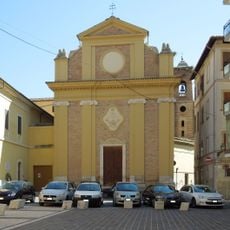
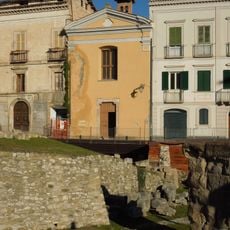
The Church of Saint Mary in Platea stands on Campli's main square, which gives the church its name. The present building dates from before 1395, when it was raised to collegiate status. Its central facade is a neoclassical composition of two orders of niches and pilasters, attributed to Giovanni Antonio Fontana of Penne, flanked by two sections of squared stone and tufa from the medieval church. The interior has three naves.
The present church was built before 1395 on a pre-1000 crypt and became a collegiate church that year. Pope Clement VIII made it a cathedral in 1600 with the bull Pro Excellenti praeminentia; the diocese was suppressed on 27 June 1818 and returned to Teramo. The west aisle was added in 1470 under pievano Cipriano Quintavalle, the east aisle in 1561, and the facade was rebuilt after the 1703 L'Aquila earthquake.
The wooden ceiling displays paintings created by the Roman School and enriches the interior with artistic detail. Walking through the side aisles, you can find a painted cross from the 14th century and a Madonna with Child created in 1577.
The church stands on the main square of Campli, the platea that gives it its name. The interior is divided into three naves; the presbytery holds the 17th-century bishop's throne and the carved wooden choir of the canons. The facade mixes a neoclassical central front with medieval stone and tuff sections at the sides.
The church keeps the 17th-century bishop's throne and the carved wooden choir of the canons in the presbytery. Since 1968 Campli has been a titular see; Renato Tarantelli Baccari, auxiliary bishop of Rome, was appointed to it on 21 November 2024.
The community of curious travelers
AroundUs brings together thousands of curated places, local tips, and hidden gems, enriched daily by 95,039 contributors worldwide.