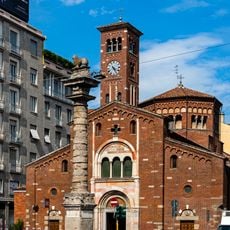
San Pietro Celestino church, Baroque church in central Milan, Italy.
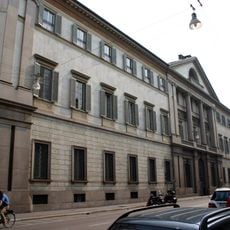
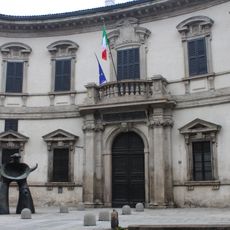
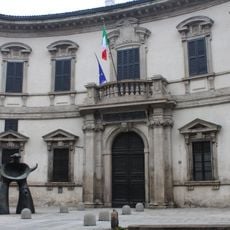
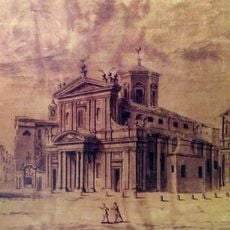
San Pietro Celestino is a church on Via Senato in central Milan, once facing the Navigli canal ring. Its interior has a rectangular plan with a single nave under a barrel vault; five chapels open on each side, separated by Corinthian pilasters, with arches of two alternating heights. The facade, rebuilt in the early 1900s in moulded concrete, follows Marco Bianchi's unfinished 1735 design.
The site began in 1173 as a meadow granted to the Valdesi for a schola; in 1274 a hospice was founded during the stay of hermit Pietro del Morrone, later Pope Celestine V. The Celestine Benedictines took over the monastery in 1317. In 1735 the Roman architect Marco Bianchi rebuilt the church, narrowing it by one arm's width and adding a facade in the fiorito barocchetto style; the weathered sandstone facade was replaced in the early 1900s with a cement cast.
The church now serves the Coptic Christian community from Egypt, bringing together worshippers from different cultural backgrounds within a historic Italian monument. This role reflects how religious spaces evolve to embrace changing neighborhoods and populations.
The church is located on Via Senato in central Milan and is easily accessible from the main public transportation network. Visitors should be aware that this is an active place of worship, so visiting hours may be limited and respectful conduct is expected.
The church keeps the tomb of Gaspare Aselli (1581–1626), a surgeon and anatomy professor at the University of Pavia remembered for describing the lacteal vessels. The writer Paolo Mezzanotte called the building "almost a piece of eighteenth-century porcelain translated into stone", squeezed between a Piermarini-style block and the canon's house.
The community of curious travelers
AroundUs brings together thousands of curated places, local tips, and hidden gems, enriched daily by 94,214 contributors worldwide.