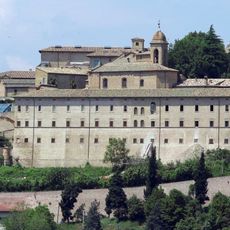
Abbazia di San Vincenzo, Benedictine abbey near Furlo Gorge in Acqualagna, Italy
Abbazia di San Vincenzo stands on the left bank of the Candigliano along the via Flaminia, near the Furlo Gorge. Its church has a simple gable facade with a round-arched portal topped by a 13th-century carved stone architrave and a reused Roman cornice. Inside, a single nave ends in an apse with a pointed-arch window; the presbytery is raised above a crypt divided by six columns.
The abbey is documented from 970, when the relics of Saint Vincent of Bevagna were sold to Theodoric, bishop of Metz. It stands on the left bank of the Candigliano along the Via Flaminia, where the Roman municipium of Pitinum Mergens had been abandoned. In 1246 a fire during a territorial dispute with Cagli damaged it; the church was rebuilt in 1271, as the inscription on the portal architrave records.
The abbey's name comes from the relics of Saint Vincent, bishop of Bevagna and martyr in 303, brought here after the Lombards destroyed Bevagna in the 6th century; a 970 document records their sale to Theodoric, bishop of Metz. Saint Romuald stayed in 1011 and Saint Peter Damian was named abbot in 1042-1043, writing the Vita beati Romualdi here.
The abbey stands on the left bank of the Candigliano, in the Pianacce locality of Acqualagna, along the route of the ancient Via Flaminia near the Furlo Gorge. The church entrance is on the side facing the road, and the blocked arches of the former right nave are visible on the flank of the building. The presbytery is raised and reached by a narrow central stair of 15 steps above the crypt.
An inscription on the facade documents the monastery's restoration after a destructive fire, showing the monks' determination to rebuild. This marking is one of the few visible signs of the complex's turbulent medieval past.
The community of curious travelers
AroundUs brings together thousands of curated places, local tips, and hidden gems, enriched daily by 95,041 contributors worldwide.