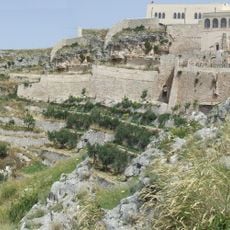
Hypogea in Siponto, Archaeological burial site in Siponto, Italy
The Hypogea in Siponto are underground burial chambers carved into limestone and connected by a network of passages. The site consists of several structured rooms where graves were arranged in an organized layout.
The caves, partly carved by the sea and partly by human hands, were inhabited from the Neolithic to the Iron Age, then served as pagan burial grounds for Roman Siponto. The first Christian Sipontines turned them into rock churches and tombs cut into the tuff, with ambulatories and arcosolia. They remained a necropolis until the 13th century, when Siponto was abandoned and Manfredonia was founded.
The name Siponto survives in the hypogea, which served the first Christians of the town as rock churches for early rites as well as for burials. In the Capparelli hypogea, Greek crosses are carved into the tuff, and small niches were cut to hold oil lamps. The Scoppa complex was dedicated to Saints Stephen and Agatha and attributed to Bishop Lorenzo Maiorano.
The hypogea lie in different spots around Siponto: the Capparelli group at Masseria Capparelli, the Santa Maria Regina chambers beneath the modern parish church of that name, and the Scoppa hypogea at the edge of and inside the Siponto pinewood. The Capparelli chambers were long used as straw stores, animal shelters and finally an illegal dump, so surfaces are worn and lighting is poor; bring a torch and sturdy shoes.
In the Capparelli hypogea, the walls carry niches cut to hold oil lamps and Greek crosses carved into the tuff, alongside single, double and multiple tombs and small loculi sized for children. The Scoppa complex, found in 1937 during land reclamation, kept traces of 5th-6th century polychrome mosaics and a sarcophagus lid pierced with a hole for offerings to the dead.
The community of curious travelers
AroundUs brings together thousands of curated places, local tips, and hidden gems, enriched daily by 93,421 contributors worldwide.