Santuario di San Matteo apostolo, Benedictine monastery and shrine in San Marco in Lamis, Italy.
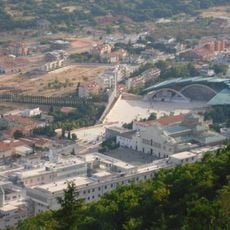
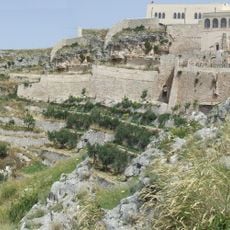
The Santuario di San Matteo apostolo, formerly the convent of San Giovanni in Lamis, stands about two kilometres east of San Marco in Lamis on the slopes of Monte Celano (871 m), among hornbeams and ashes above the Starale valley. Its buttresses and position recall a fortress. A staircase added in 1838 leads to the entrance, then through arches and vaults to a rectangular cloister with a 16th-century loggia and a medieval courtyard holding a well topped by a statue of the Archangel Michael. A long corridor reaches the single-nave church, whose raised presbytery is in polychrome marble by Neapolitan masters; a balcony was built on the eastern side in 1926.
A church and hospice already existed here by the 4th-5th century, serving pilgrims walking from Abruzzo and Molise to the grotto of Monte Sant'Angelo, a day's march away. The first documented date is 1007, when Benedictine monks held it as San Giovanni De Lama; the ruins of the San Nicola convent less than a kilometre off mark the old Via Francigena. Clement V gave it to the Cistercians of Santa Maria di Casanova by bull of 20 February 1311, and the Observant Friars took over by papal bull of 14 February 1568.
The complex is still canonically called Convento di San Giovanni in Lamis, though it became known as San Matteo after receiving a molar tooth relic from Salerno Cathedral. On 21 September, the feast of Saint Matthew, the statue is carried in procession by residents of Cerignola, of which he is patron, and the faithful are anointed with oil from the lamp beside the relic, kept in a 17th-century silver reliquary.
The complex sits about two kilometres east of San Marco in Lamis on the slopes of Monte Celano, at 871 m, reached by a road off the valley of the Starale. The central facade is approached by a staircase added in 1838, and inside, a long corridor links the cloister to the single-nave church. The 1926 balcony on the eastern side marks the church exterior.
The shrine preserves a relic attributed to Saint Matthew the Apostle that draws many believers during the annual celebration. This venerated relic remains the central reason for the site's continued importance as a pilgrimage destination.
The community of curious travelers
AroundUs brings together thousands of curated places, local tips, and hidden gems, enriched daily by 94,548 contributors worldwide.