San Severino abate, Romanesque church in San Severo, Italy.
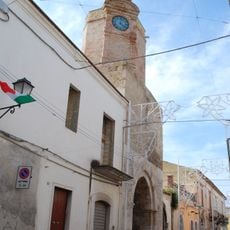
San Severino abate is the oldest sacred building in San Severo, first documented in 1059. Its plan is a Latin cross: the nave was extended and a transept added after 1295, and the left arm is irregular because adjacent private land could not be occupied. The 12th-century stone bell tower forms the inner wall of the right transept arm, and the secondary stone facade reuses the portal of Frederick II's palatium Bellumvidere, attributed to Bartolomeo da Foggia, with a six-ray rose window.
The church is first documented in 1059 and underwent major transformations, including a reconsecration in 1224 and reconstruction after the 1627 earthquake. These phases shaped the current structure and show how the building endured through several centuries.
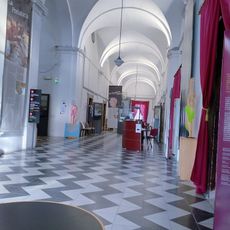
The name San Severo comes from Saint Severinus, whose cult spread along the Via Sacra Langobardorum and drew pilgrims toward Monte Sant'Angelo. Inside, the 18th-century wooden ceiling by Romolo Baratta of Avellino is painted with the Miracle of Saint Severinus, for which a preparatory sketch by Francesco Solimena survives. The church is also the city's civic temple, and a plaque records its reopening on 27 April 2008.
The church was closed as unsafe in January 1960 and reopened for worship on 27 April 2008, a reopening marked by a commemorative plaque. Much of the 18th-century painted decoration on the walls still awaited recovery at that time. Access is tied to religious services.
The building features an intentionally tilted apse designed to represent a reclined head within the Latin cross structure. This unusual architectural choice is often overlooked by visitors and gives the interior space a subtle, surprising quality.
The community of curious travelers
AroundUs brings together thousands of curated places, local tips, and hidden gems, enriched daily by 94,575 contributors worldwide.