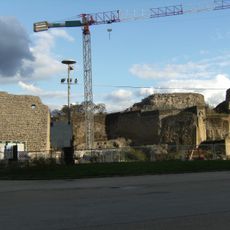
Carcere Borbonico, Historical civil building museum in Avellino, Italy
Carcere Borbonico is a former Bourbon prison begun in 1827 to designs by Giuliano de Fazio, who drew on Jeremy Bentham's Panopticon. Its hexagonal plan is built around a central tholos with a domed chapel on the second floor, and rear pavilions form a semicircular hemicycle. A drawbridge crossed the deep moat, now covered to widen the road. The complex houses Museo irpino sections, an auditorium and exhibition rooms.
The prison was planned after the 1806 transfer of the Principato Ultra courts from Montefusco to Avellino, and Ferdinand I of Bourbon funded it with 60,000 ducats. Giuliano de Fazio's design, inspired by Bentham's Panopticon, was built from 1827; the central building was finished in 1837 and a drawbridge over the moat followed in 1839. The 1980 earthquake closed it and inmates moved to Bellizzi.
The male detention wings now hold the lapidary, a visitable storage area, the Risorgimento section and the scientific collection, and these are the most richly decorated pavilions. The provincial picture gallery displays works by 20th-century Irpinian painters. The complex also houses the CRBC, the Mibac catalogue office, an auditorium and rooms for temporary exhibitions.
The complex stands in Avellino's historic centre, and covering the old moat allowed the road beside it to be widened. The former men's detention wings hold the lapidary, the visible storage, the Risorgimento section and the scientific collection, and are the most richly decorated. A loggia and corridors run along the first floor, while the domed chapel occupies the second.
A small circular chapel sits at the center of the five prison wings, serving as an architectural focal point of the compound. This religious space was woven into the daily structure of the facility and remains a noteworthy detail of the building's original design.
The community of curious travelers
AroundUs brings together thousands of curated places, local tips, and hidden gems, enriched daily by 94,561 contributors worldwide.