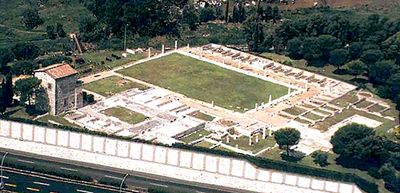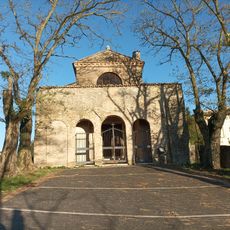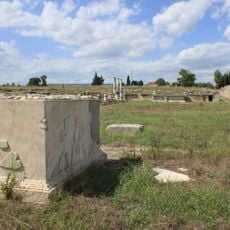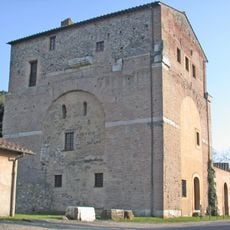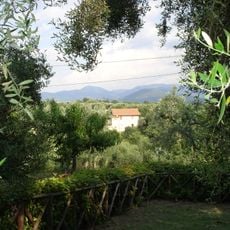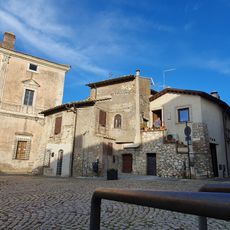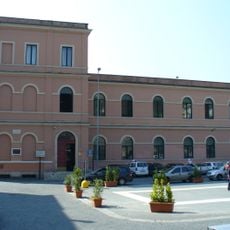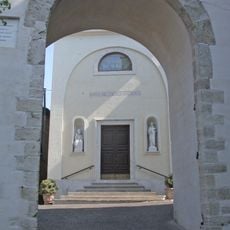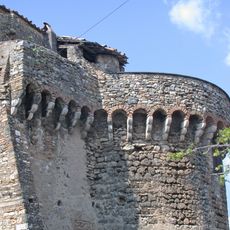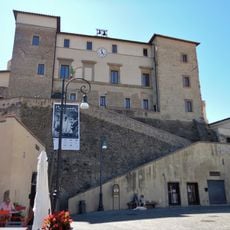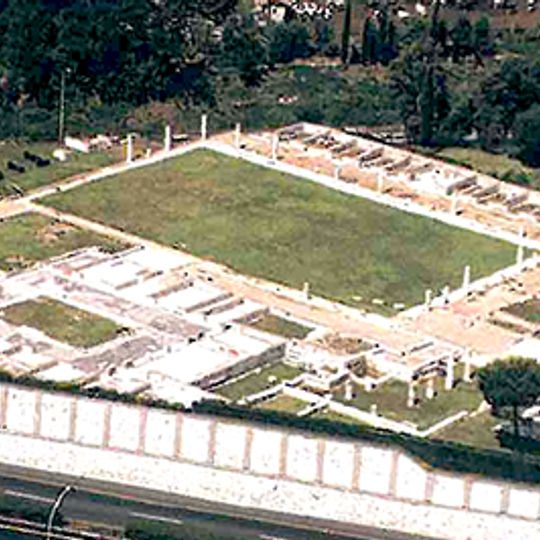
Villa of the Volusii Saturnini, Archaeological site near Fiano Romano, Italy.
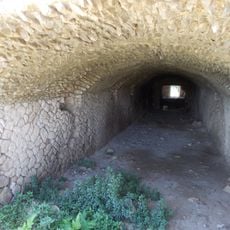
The Villa dei Volusii Saturnini stands near Fiano Romano beside the Via Tiberina, about 400 metres from Lucus Feroniae. Built on an embankment above the lower Tiber valley, it has two levels: the upper residential floor rests on a cryptoporticus and held an atrium, triclinium, tablinum, peristyle, garden and lararium. Around sixty rooms are known, some with polychrome geometric mosaics; room 23 preserves one of the oldest opus sectile floors.
The estate was built in the middle of the 1st century and belonged to a wealthy family with considerable influence during the early imperial period. It was eventually abandoned and buried under layers of earth until construction work uncovered it in the mid-20th century.
The villa's name comes from the Volusii Saturnini, a senatorial family whose consuls included Lucius Volusius Saturninus (consul 12 BC) and his son Quintus (consul 56 AD). In the peristyle's central room, a masonry counter bore a long eulogy to both men, and fragmented portrait statues of the family, including Lucius's wife Cornelia, were found around the courtyard. The lararium held statues of the family's ancestors.
The site is reached from the Lucus Feroniae archaeological area by a footbridge over the SP 15/A Tiberina, which separates the two sites. There is also an entrance from the Feronia Ovest service area of the A1 motorway, in the direction of Rome. Entry is free, and the villa is managed under concession by Autostrade per l'Italia.
The site was discovered by chance during construction of one of Italy's major highways passing nearby. Systematic excavations that followed unearthed numerous artifacts that deepened understanding of daily life in this historical period.
The community of curious travelers
AroundUs brings together thousands of curated places, local tips, and hidden gems, enriched daily by 94,046 contributors worldwide.