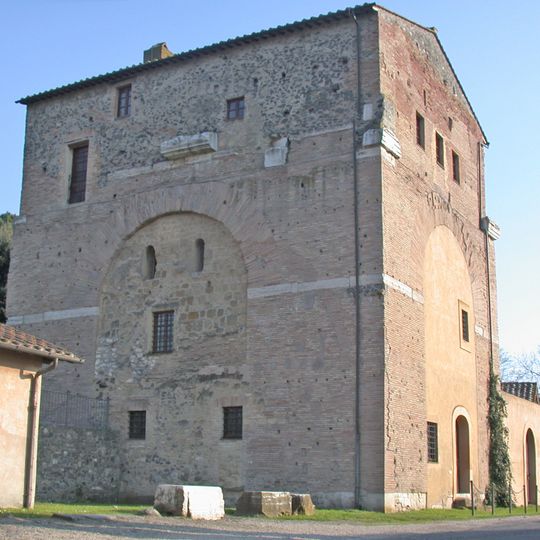
Arch of Malborghetto, Ancient Roman triumphal arch on Via Flaminia, Rome, Italy
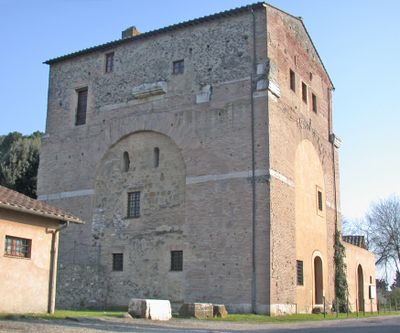
The Arch of Malborghetto is a Roman quadrifrons arch standing along the Via Flaminia, a few miles north of Rome, built with four large openings set within a massive rectangular block of brick and tufa stone. The structure still stands to a considerable height and retains much of its outer shell, even though it was heavily altered over the centuries.
The monument contains brick stamps pointing to Emperor Diocletian's reign and was most likely built around the turn of the 3rd and 4th centuries. It is associated with Constantine I's march on Rome in 312, before his victory at the Milvian Bridge.
During the Middle Ages, the four openings of the arch were walled up and the structure was turned into a church with a cross-shaped plan. You can still see today where the medieval masonry was added over the original Roman stonework.
The arch stands along the Via Flaminia outside the city and is easiest to reach by car or bus. A small archaeological museum inside the building displays sculptures and inscriptions from the surrounding area, but it opens only on certain days, so it is worth checking in advance.
The name Malborghetto, meaning 'bad little village', refers to the small settlement that grew around the structure over time, not to the arch itself. This overlap between the building and the place name still causes some confusion for first-time visitors.
The community of curious travelers
AroundUs brings together thousands of curated places, local tips, and hidden gems, enriched daily by 92,341 contributors worldwide.