Tomb of the Plautii, Roman funerary structure near Ponte Lucano, Tivoli, Italy.
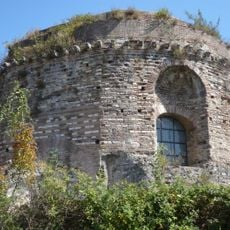
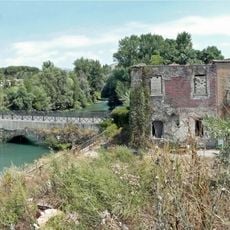
The Tomb of the Plautii near Tivoli is a monumental tomb from the early 1st century AD. Originally a tall cylinder on a square base, topped by a dome and clad in travertine, it resembled the tomb of Caecilia Metella. In the 15th century it was hollowed out and turned into a crenellated tower guarding the nearby Ponte Lucano over the Aniene.
This funerary monument dates to the 1st century AD and belonged to the Plautii family, with Marcus Plautius Silvanus, a consul under Augustus, mentioned in its inscriptions. In 1465, Pope Paul II converted it into a defensive tower.
The inscriptions on marble slabs record the names and accomplishments of deceased family members, showing how prominent families displayed their status through elaborate burial monuments.
The mausoleum stands beside the Ponte Lucano on the road near Tivoli, next to the Aniene. It is now managed by the Istituto Villa Adriana e Villa d'Este (MiC). Look for the two large marble slabs with inscriptions set beside the monument and the smaller one embedded high on the structure.
The mausoleum was hollowed out and turned into a crenellated tower in the 15th century to guard the crossing of the Ponte Lucano over the Aniene. Its original form, a tall cylinder on a square base sheathed in travertine, is compared to the tomb of Caecilia Metella. A small inscription is set into the upper part of the structure.
The community of curious travelers
AroundUs brings together thousands of curated places, local tips, and hidden gems, enriched daily by 94,553 contributors worldwide.