Trieste City Hall, Municipal palace in Piazza Unità d'Italia, Trieste, Italy
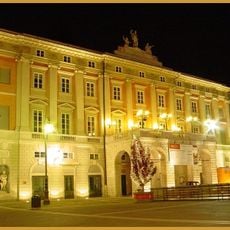
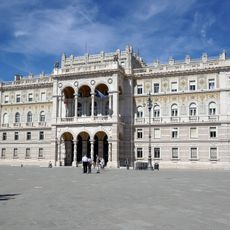
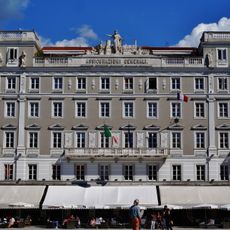
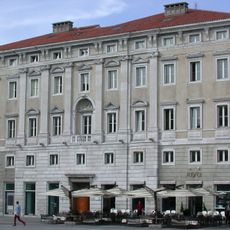
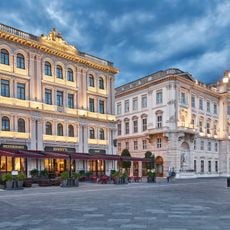
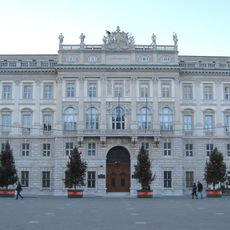
Trieste City Hall, designed by Giuseppe Bruni and completed in 1875, occupies the eastern side of Piazza Unità d'Italia with its main facade facing the sea. The eclectic facade has two four-storey side wings and a taller central section with a clock tower. Atop the tower, two bronze figures called Micheze and Jacheze strike a bell on the hour.
Construction took place between 1873 and 1875 under architect Giuseppe Bruni while the city remained under Austro-Hungarian rule. This period shaped the building as an architectural symbol of contemporary urban ambition in the region.
Triestines gave the building nicknames still remembered today: "palazzo Cheba" because it resembled a large birdcage, and "palazzo Sipario" because its bulk hid the old city's buildings behind the square. The clock tower's two bronze Moors, Micheze and Jacheze, strike the hours on a bell; their names come from the Slovene Mihec and Jakec.
The main facade faces the sea on Piazza Unità d'Italia, with the central clock tower between two four-storey wings. The two Moors, Micheze and Jacheze, strike the hours on a bell at the top; the bronze originals, installed in January 1876, are now at the entrance of Castello di San Giusto.
The two figures striking the bell atop the clock tower, nicknamed Micheze and Jacheze (from Slovene Mihec and Jakec), were cast in bronze by sculptor Fausto Asteo of Ceneda and installed between 5 and 7 January 1876, first ringing at noon on 14 January. In 1972 they were replaced by copies; the restored originals now stand at the entrance of San Giusto Castle.
The community of curious travelers
AroundUs brings together thousands of curated places, local tips, and hidden gems, enriched daily by 93,085 contributors worldwide.