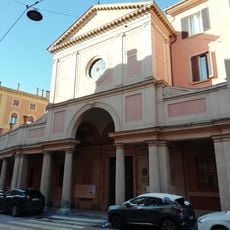
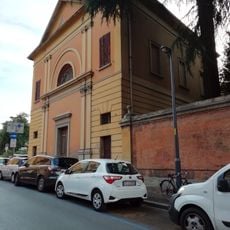
Villa Baruzziana, Neoclassical villa in Bologna, Italy
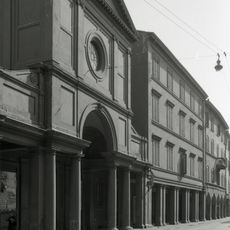
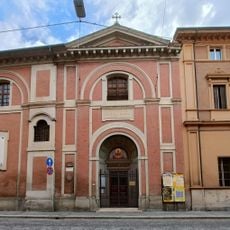
Villa Baruzziana is a four-story neoclassical villa on the Colle dell'Osservanza, outside Porta San Mamolo. Its double-height facade was designed by architect Enrico Brunetti Rodati (1813–1859). Inside are a grand ballroom shaped like an amphitheater, a chapel, and two terraces on the piano nobile. The grounds included a large park, cellars, and an icehouse.
The residence was built in 1836 by sculptor Cincinnato Baruzzi as both his home and an intended art museum. During the 1849 siege of Bologna, imperial forces requisitioned the building, causing significant structural damage and destroying or removing many artworks.
Baruzzi had the 'third cast' of Canova's Three Graces installed in a pavilion on the site as early as 1833, inherited from his master along with other relics. The villa, which he called L'Eliso, was intended as a museum house on the model of Canova's home in Possagno, and it held both his own works and reproductions of Canova's.
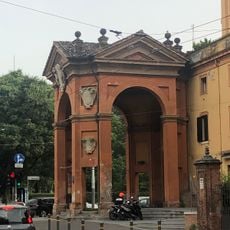
The villa is now a private care institute, so the building and its park are not open to casual visitors; access is reserved for patients and staff. It stands on the Colle dell'Osservanza outside Porta San Mamolo, uphill from the city centre, and can be reached on foot or by bus along the road to San Mamolo. The exterior and the gate can be seen from the street.
The ballroom's amphitheater shape is not its only curiosity: in 1833, before the villa existed, Baruzzi installed a pavilion on the site to house the 'third cast' of Canova's Three Graces, which he had inherited from his master. The cast was later joined by other Canova relics, and Baruzzi considered turning the finished villa into a house-museum like Canova's in Possagno.
The community of curious travelers
AroundUs brings together thousands of curated places, local tips, and hidden gems, enriched daily by 94,989 contributors worldwide.