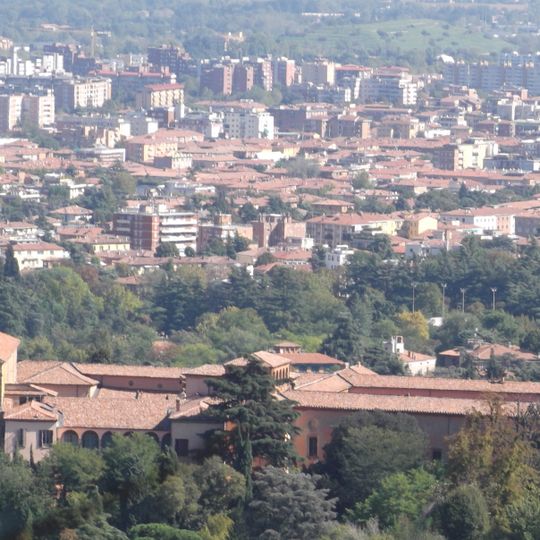
San Michele in Bosco, Renaissance monastery on a hill in Bologna, Italy
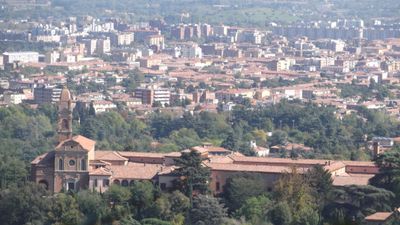
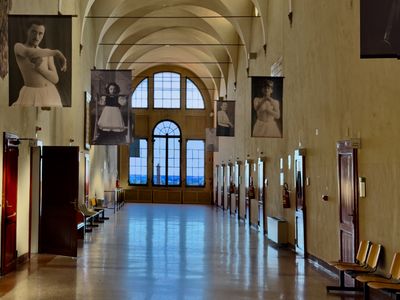
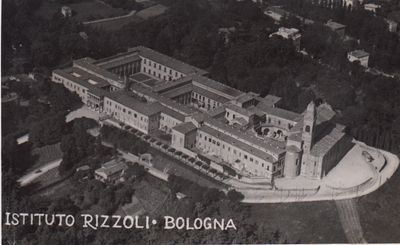
San Michele in Bosco is a religious complex on a hill above Bologna, made up of the church of San Michele in Bosco and the adjoining Olivetan monastery. The church has a Renaissance facade by Biagio Rossetti and his workshop, with a marble portal of 1521 by Baldassarre Peruzzi, a single nave with four side chapels and a presbytery. The monastery, finished in the late 16th century, is built around an octagonal cloister designed by Pietro Fiorini and frescoed by Ludovico Carracci and his pupils between 1602 and 1603. A long vaulted corridor runs through the complex.
Monastic structures existed here by the 4th century, and the site was dedicated to the Archangel Michael; tradition holds the community was dispersed by the Goths and later destroyed in the Hungarian invasions of 906. Augustinian monks are documented from 1107, and in 1364 Pope Urban V installed Olivetan monks, who rebuilt the church after its destruction in 1430, finishing it largely by 1523. The monastery was expropriated in 1797 under Napoleon and later served as a barracks and a prison.
The complex holds artworks from different periods, including frescoes by Ludovico Carracci and decorations by Giorgio Vasari in the former refectory. These pieces reflect how artists shaped the spiritual life of the community over centuries.
The grounds are now part of the Rizzoli Orthopedic Institute and are open to visitors arriving by public transportation. City bus lines connect the site well to other parts of Bologna, and the hilltop location offers views across the city.
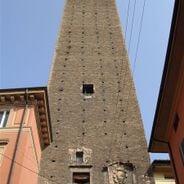
The long vaulted corridor frames the Asinelli Tower in the distance, producing the "telescope effect": as you walk backwards away from the window, the tower appears to grow rather than shrink. Marco Costa and Leonardo Bonetti of the University of Bologna studied this paradox in recent years.
The community of curious travelers
AroundUs brings together thousands of curated places, local tips, and hidden gems, enriched daily by 92,805 contributors worldwide.