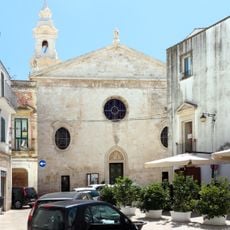
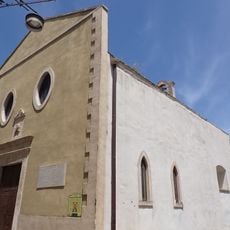
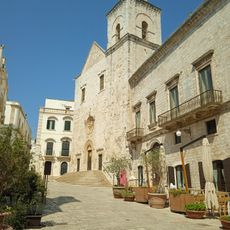
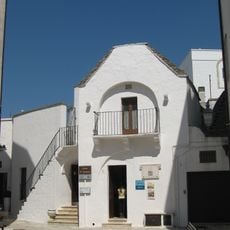
Casa Rossa, Italian national heritage palazzo in Alberobello, Italy.
Casa Rossa is a large two-storey building of about thirty rooms of varying size in the Albero della Croce district, five kilometres south-west of Alberobello on the road to Mottola, near the border with Noci. It stands on a hill and since 2001 has been a Luogo della memoria, a place of memory.
Donated by the priest Francesco Gigante in his will of 2 December 1887, Casa Rossa opened as an agricultural school, becoming a moral entity on 9 January 1896. From 1906 to 1939 it housed the Scuola Pratica d'Agricoltura, an elementary school and a technical agrarian school with a boarding house. In July 1940 the Ministry of the Interior requisitioned it as a police internment camp, active until 1943.
Since 2001 Casa Rossa has been a Luogo della memoria, a place of memory. The internees left traces in Alberobello: German Jewish painters and musicians produced ink drawings, tempera works, sketches and musical scores, and architects, engineers and doctors worked in exchange for food or clothing.
Casa Rossa stands in contrada Albero della Croce, about five kilometres south-west of Alberobello on the road to Mottola, near the border with Noci, on a hill. It is a two-storey building of around thirty rooms; since 2001 it has been a Luogo della memoria, so access to the interior depends on the memorial site's arrangements rather than on the town centre.
Among the internees were German Jewish painters and musicians who left drawings, ink and tempera works and musical scores in Alberobello. Many Jewish architects, engineers and doctors held there worked professionally in exchange for food or clothing. The English playwright Arthur Spurle, a historian of Neapolitan theatre, was also held at the site.
The community of curious travelers
AroundUs brings together thousands of curated places, local tips, and hidden gems, enriched daily by 93,115 contributors worldwide.