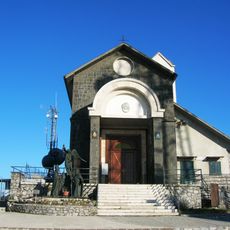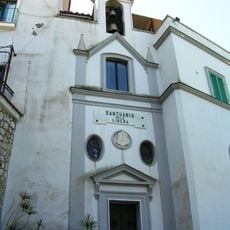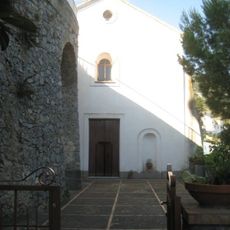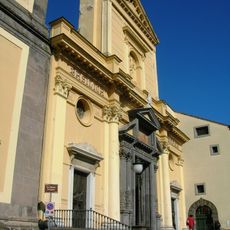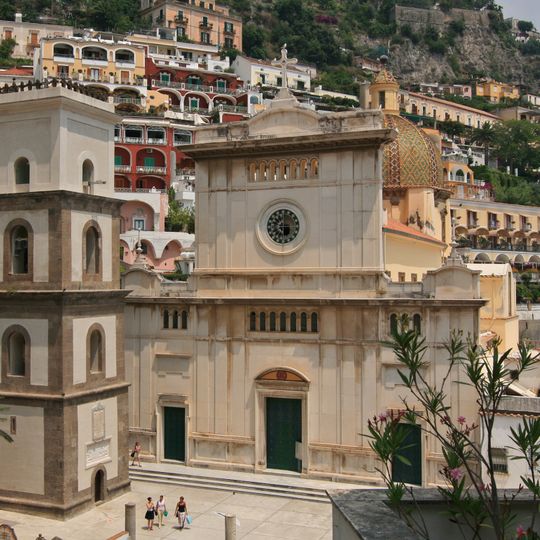
Santa Maria Assunta, Medieval church in Positano, Italy.
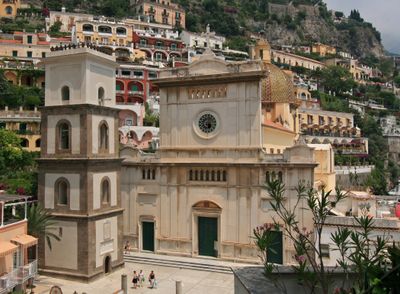
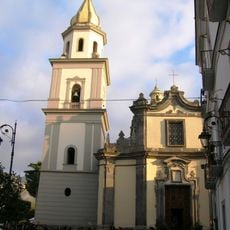
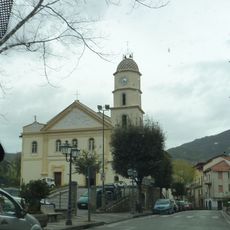
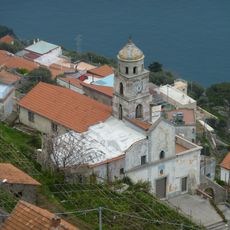
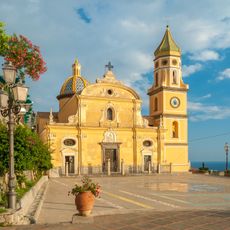
Santa Maria Assunta is a church building in Positano that was originally constructed in the 10th century as a Benedictine monastery. It stands out for its distinctive dome covered with yellow and green majolica tiles, visible from various points throughout the town.
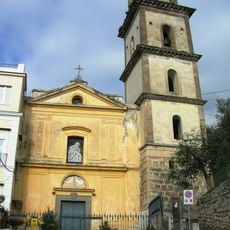
The church's origins trace to an 8th-century monastic settlement on the remains of a Roman villa destroyed in the 79 eruption; documents mention it in 994, 1009 and 1071, and in 1159 the bishop of Amalfi Giovanni II dedicated it to Maria. In 1440 the abbot Antonio Acciappaccia left with his monks for Cava, and in 1441 the abbey became a secular commendam. After the 1777-1778 reconstruction, bishop Antonio Puoti consecrated it on 10 August 1783. The bell tower was built in 1707.
The venerated image is a Byzantine-style icon of the Virgin, kept in a niche built for it during the 1777-1778 renovation; on 15 August 1783 Bishop Antonio Puoti placed a golden crown on it. The name Positano itself is linked to the legend: sailors heard the cry "Posa, posa" telling them to set the icon down on the beach.
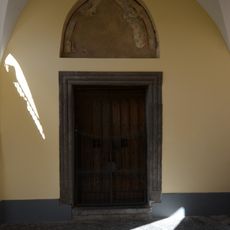
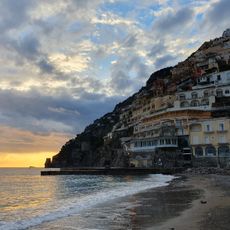
The church stands on a hill above the beach, reached by steps from the seafront; the rectangular forecourt in front of the facade doubles as a terrace looking down on the beach. The facade faces the sea, and the interior is entered through three portals, the central one in bronze. The 1978 reordering following the Second Vatican Council reshaped the interior layout.
The bell tower was built in 1707, and the church was restored in 1963. The dome is clad in green, blue and yellow majolica tiles and has a central lantern with a conical roof; the tall marble façade hides it from the square in front.
The community of curious travelers
AroundUs brings together thousands of curated places, local tips, and hidden gems, enriched daily by 93,119 contributors worldwide.