Reggia di Quisisana, Royal palace in Castellammare di Stabia, Italy
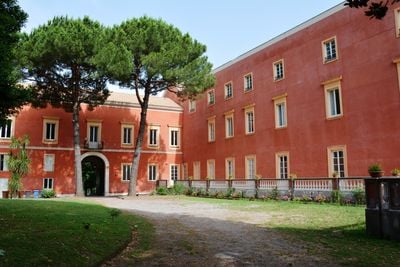
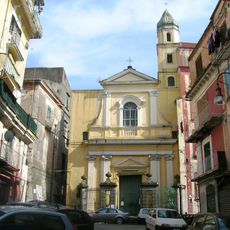
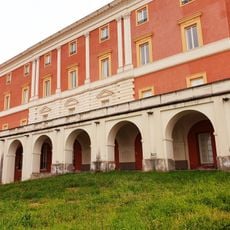
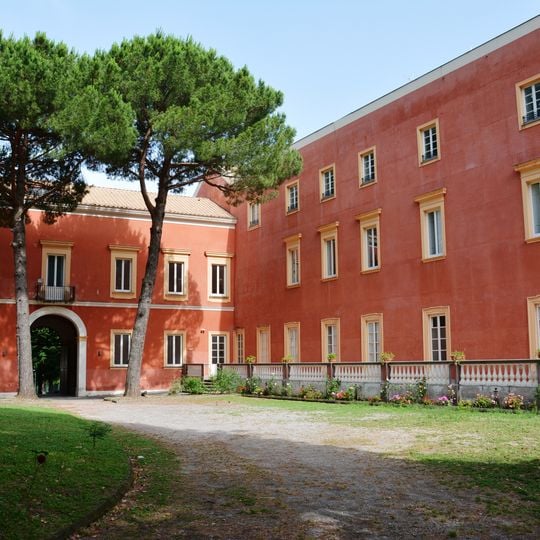
The Reggia di Quisisana is a palace in Castellammare di Stabia whose wings form an L around a courtyard. The left wing has an arched entrance with a small balcony above and a low-pitched roof with a pale yellow edge; the taller right wing has a stone balustrade along its base. Flat red-orange panels face the facade, and rectangular windows framed in pale yellow stone are set in regular rows.
Documented before 1280 in records of Charles I of Anjou and mentioned in Boccaccio's Decameron, the palace was enlarged under the Angevins into two orthogonal wings. In 1758 Ferdinand IV began works that unified the blocks into an L shape, completed under Ferdinand II by 1790. After serving as Hotel Margherita and Royal Hotel Quisisana, it was restored from 2002 to 2009 and since 2020 houses the Museo archeologico di Stabia Libero D'Orsi.
The name Quisisana is traced either to the Latin Domus de Loco Sano, 'house at a healthy place', or to Charles II of Anjou's words 'Qui si sana' after he recovered here. Under the Bourbons the king held parties in the palace that were open to the citizens of Castellammare di Stabia.
Since 2020 the palace has housed the Museo archeologico di Stabia Libero D'Orsi, so a visit is indoors and tied to museum opening hours rather than to any festival. The building stands in the hillside frazione of Quisisana, above Castellammare di Stabia, reached by road from the town centre. Restoration work begun in May 2002 ended in 2009, two years behind schedule.
The name may derive from the Latin phrase 'Domus de Loco Sano' meaning 'house at a healthy place,' or from King Charles II, who reportedly said 'Qui si sana' after recovering from illness there. This dual origin reflects both the location's natural advantages and its reputation as a place of recovery.
The community of curious travelers
AroundUs brings together thousands of curated places, local tips, and hidden gems, enriched daily by 94,466 contributors worldwide.