Suzakumon, Reconstructed palace gate in Nara, Japan
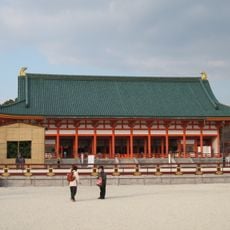
Suzakumon is the reconstructed main south gate of Heijō Palace in Nara, a two-storey timber structure of five bays with three passages. It is painted vermilion with white plaster panels between the beams of the upper storey, and both the wide lower roof and the narrower upper roof are clad in dark grey tiles, their upturned corner ridges tipped with golden ornaments. A red railing runs along the upper balcony, and the red posts of the lower level stand on a stone base with steps.
The gate originated in the 8th century during the Nara period as the main entrance to the Imperial Palace and served high-ranking visitors and court officials. Modern reconstruction in the 1990s aimed to restore its historical appearance for future generations.
The name comes from Suzaku, the Vermilion Bird, guardian of the south in the Four Symbols of Chinese astronomy; in 714 the gate's old name, Otomo Gate, after the Otomo clan, was changed to this Chinese-style one. Foreign dignitaries were received here by the Emperor. The vermilion paint and white plaster panels of the reconstruction follow that southern guardian.
The gate stands in the open Heijō Palace site, reached on foot from the nearest station; the reconstructed gate is outdoors and can be viewed at any time. The site is large and exposed, so bring water and sun protection in summer and allow time to walk between the gate and the museum exhibits.
The 1998 reconstruction mixes Japanese cypress wood and tiles with concrete to resist earthquakes, and most of the work was done by the Takenaka Corporation. Because no structural remains survived, the design was a conjecture based on comparable architecture elsewhere. The gate later appeared in the 2008 Fuji TV drama Shikaotoko Aoniyoshi.
The community of curious travelers
AroundUs brings together thousands of curated places, local tips, and hidden gems, enriched daily by 93,156 contributors worldwide.