Tama Cemetery, Public cemetery in Fuchu City, Japan.
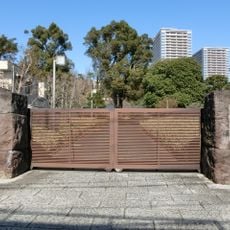
Tama Cemetery covers 128 hectares split between Fuchu and Koganei, making it the largest of Tokyo's metropolitan cemeteries. Its flat ground is laid out in numbered blocks of granite headstones—pale grey upright slabs and darker polished markers edged by low kerbed borders—with clipped shrubs and small conifers between plots. A gravel path runs up the centre, and the main gate is built of rough-cut stone pillars hung with a plaque bearing white Japanese characters.
The site opened in 1923 as Japan's first public park cemetery, created to address Tokyo's need for burial space beyond the city. This marked a shift in how Japan approached cemetery design, blending functional and recreational purposes in a single place.
The cemetery is known for the graves of writer Mishima Yukio (1925–1970), painter Kishida Ryūsei (1891–1929) and screenwriter Noda Kōgo (1893–1968), who worked with director Ozu Yasujirō. Visitors leave flowers and small offerings at these plots, and the grave registers kept by the administration help them locate a specific grave by block, type, side and number.
The main gate and administrative office sit at the south-east corner of the grounds, where the bus street runs north to the Tokyo Route 14 (Higashi-Yamato) road. Keio buses serve the whole bus street, with stops at Reien-Minami 7-chome and Reien-Chuo 20-chome. Cars may enter only at the main gate, the Koganei gate and the junction of the bus street and Omawari; inside, vehicles may park anywhere along the roads. Graves are located by block (1–26), type, side and number.
During World War II, aircraft from a nearby airfield took shelter on these grounds, and some structures still show damage from military actions of that era. This hidden chapter reveals how the place served purposes beyond burial during times of conflict.
The community of curious travelers
AroundUs brings together thousands of curated places, local tips, and hidden gems, enriched daily by 93,172 contributors worldwide.