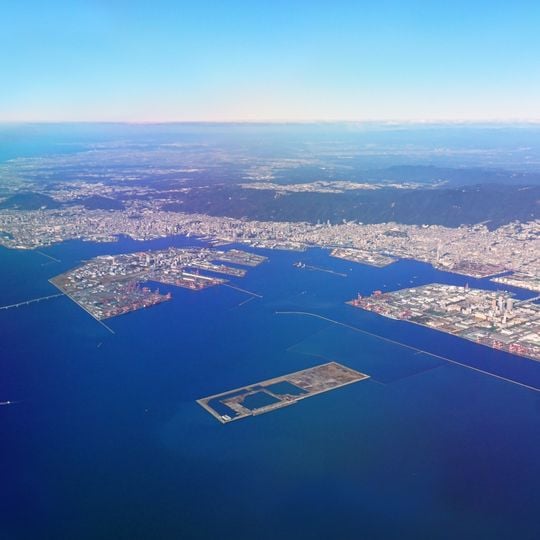
Port of Kobe, Maritime port in Kobe, Japan
The Port of Kobe occupies a stretch of Osaka Bay where the Rokkō mountains fall steeply to the water, giving deep draft close to shore. Its 34 container berths and 3.89 km² of port area are spread across artificial islands such as Port Island and Rokkō Island, built with earth moved by conveyor belts. Photographs show flat rectangular islands of warehouses, stacked red and orange containers, gray silos and cranes, with a long breakwater and a concrete quay lit by small lamps.
The port opened to international trade in 1868 following a mid-1800s trade agreement, making Kobe a major Japanese maritime gateway. This event marked the beginning of the city's modern maritime development.
The port area sits next to Nankin Machi, one of Japan's three largest Chinatowns, reflecting centuries of maritime trade and cultural exchange with Asia. This proximity shows how closely shipping activity was tied to merchants and immigrants arriving from overseas.
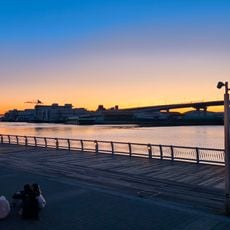
The port has passenger ferry links to Busan twice a week and to Shanghai and Tianjin once a week. The waterfront walkway along the quay is flat and lit by small lamps, with a metal footbridge leading to a floating platform. The harbor area covers 9,171 hectares, so allow time to move between the container zones and the passenger terminals.
The 1995 Great Hanshin earthquake destroyed much of the port and caused damage estimated at about ten trillion yen, roughly 2.5% of Japan's GDP at the time. Only 3% of property in the Kobe area was covered by earthquake insurance, so most losses were uninsured. The port has never regained its former rank as Japan's principal shipping port.
The community of curious travelers
AroundUs brings together thousands of curated places, local tips, and hidden gems, enriched daily by 94,577 contributors worldwide.