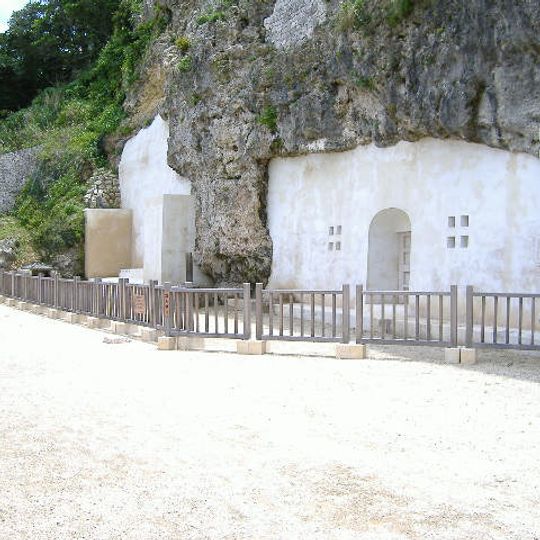
Urasoe yōdore, Royal tomb in Urasoe, Japan
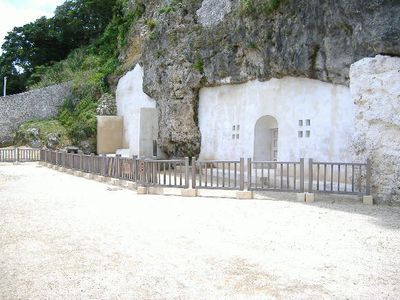
Urasoe yōdore is a royal tomb cut into a limestone cliff below Urasoe Castle, about 115 m above sea level. Two horizontal chambers open onto a walled forecourt called Ichiban-nā; the west chamber is attributed to King Eiso, the east to King Shō Nei. The white-plastered facade has a central arch and small square holes, with a low metal fence in front.
Eiso built the tomb around 1261; a Korean tile bearing the cyclical date 1273 supports the date given in the Ryūkyū-koku yuraiki. Shō Nei repaired the west chamber and added the east chamber around 1620, moving his grandfather Shō Kōgyō and father Shō I there. The tomb was badly damaged in 1945, the rock above the Kurashin-ujō tunnel collapsing, and restoration was completed in 2005.
The name yōdore means "evening calm" in the Okinawan language, referring to still water at dusk. A stone stele once stood in the burial courtyard, inscribed in both Japanese and Chinese, recording that Shō Nei repaired Eiso's tomb and moved his grandfather Shō Kōgyō and father Shō I here. The east chamber's sleeve masonry held a pair of stone lions; the right one was lost in the 1945 battle.
The site is located in Urasoe city and accessible by public transport, with local bus lines serving the nearby stop. Allow time to walk around the grounds and examine the structural details at a comfortable pace.
The two burial chambers are horizontal, cut side by side into the limestone cliff, not stacked vertically: the west chamber is attributed to King Eiso, the east to King Shō Nei. Excavations in the second garden (niban-nā) found crucibles, an anvil stone, iron slag and nails, remains of a metalworking workshop.
The community of curious travelers
AroundUs brings together thousands of curated places, local tips, and hidden gems, enriched daily by 93,251 contributors worldwide.