Taisan-ji, Buddhist pilgrimage temple in Kamiita, Japan
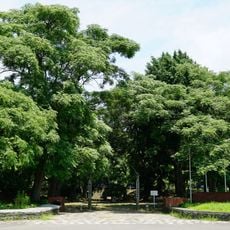
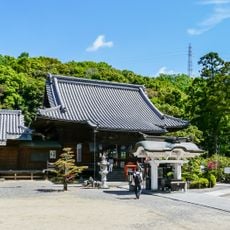
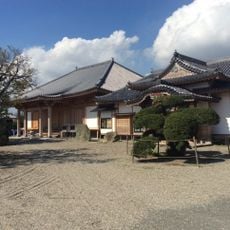
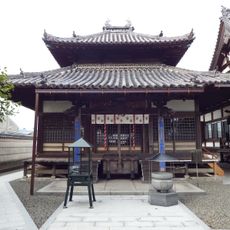
Taisan-ji is a Daigo Shingon temple on the slope of Mount Ōyama at about 450 m elevation in Kamiita, Tokushima Prefecture. Its Hondō, Daishidō, Kairō and Shōrō-mon are registered cultural properties; the Hondō was built between 1661 and 1751 and moved in 1796, the Daishidō dates from 1863. The main image is Senjū Kannon.
According to temple tradition, the monk Seihan founded the site around the 6th century, and a 600th memorial held in 1126 places his death in 526. In the early Heian period Kōbō Daishi is said to have moved the temple to its present location and installed a Senjū Kannon image received from Huiguo. The Hondō was built between 1661 and 1751 and relocated in 1796; the Daishidō dates to 1863.
The temple's name comes from Mount Ōyama, on whose 450 m slope it stands; its mountain name is Butsuō-zan. Each January, on the third Sunday, the Chikaramochi contest has competitors carry a 169 kg load — a wooden tray with an 86 kg rice cake — as far as they can, recalling the legend of the strongman Nanakujō Kanenaka. The ginkgo in the centre of the grounds is called Benkei's ginkgo, after the story that Benkei planted its seed.
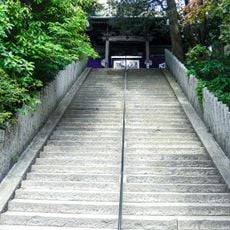
The temple stands about 450 m up the slope of Mount Ōyama (691.3 m); from the Niō-mon, roughly 260 steps climb to the bell tower gate. The summit viewpoint, one of the Tokushima Hyakkei, is reached from the precinct in about 40 minutes on foot, climbing some 230 m to the Okunoin at Kuroiwa Daigongen.
The temple's Important Cultural Property is a bronze sutra canister, 34.5 cm tall and 17.5 cm across the mouth, unearthed in 1831 from a sutra mound near the temple. Its inscription dates to the tenth month of Daiji 1 (1126), the year of the six-hundredth memorial for the founder Seihan Sōzu, who died in 526.
The community of curious travelers
AroundUs brings together thousands of curated places, local tips, and hidden gems, enriched daily by 93,629 contributors worldwide.