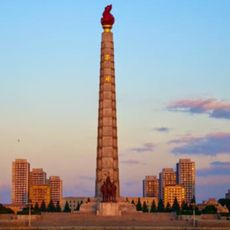
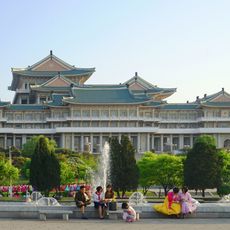
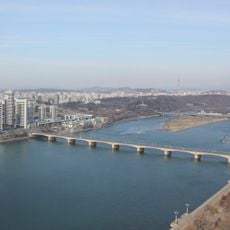
Ryongwang Pavilion, Monument and building near Taedong River, Pyongyang, North Korea.
Ryongwang Pavilion is a building with traditional Korean architecture situated on elevated ground overlooking the Taedong River in Pyongyang. The structure features characteristic curved roofs and wooden columns that extend toward the water.
The structure was originally built during the Goguryeo dynasty as Sansu Pavilion and served as part of Pyongyang's defensive infrastructure. It held strategic importance alongside Taedong Gate in protecting the city.
The pavilion carries the name Ryongwang, meaning "commanding views", given after its Joseon-era reconstruction. A plaque inside reads "First Landscape Under Heaven", inscribed by a Chinese envoy impressed by the Taedong River view. The Koryo poet Kim Hwang Won wrote two lines of a couplet on the river and hills, could not continue, and threw down his brush; the two lines hang on boards between the inner columns.
The pavilion stands on a stone-faced terrace above the Taedong River in Pyongyang's central district, next to Taedong Gate. Its south side rests on the stone platform while the north side is carried on tall square columns, so the floor sits level above the slope. Look for the plaque reading "The finest landscape under heaven" inside.
During the 16th century, the pavilion became the setting for a strategic military operation involving a kisaeng named Gye Wolhyang. This episode connects the structure to a lesser-explored chapter of local history.
The community of curious travelers
AroundUs brings together thousands of curated places, local tips, and hidden gems, enriched daily by 93,467 contributors worldwide.