Pyongyang Castle, Fortress in Pyongyang, North Korea
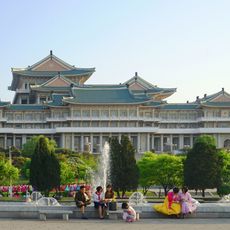
Pyongyang Castle, also called Jangan Castle, is a fortress of Goguryeo origin whose walls were built in three layers. Its gates survive as rebuilt structures: the Pothong Gate, a granite embankment with a two-storey gate tower, and the Taedong Gate, a 19-metre arched gate on a large stone base. The Ulmil Pavilion stands on an 11-metre embankment below Ulmil Peak of Geumsusan Mountain.
In 427, King Jangsu of Goguryeo moved the kingdom's capital from Gungnae Fortress to Pyongyang Castle, a site better suited to a growing metropolitan capital. The castle had already been attacked by Geunchogo of Baekje in 375. In 668 it became the seat of the Tang Protectorate General to Pacify the East, and by 676 it passed to Silla, remaining on the Silla–Balhae border. Wang Geon later recovered the abandoned site and made it Goryeo's Western Capital.
Pyongyang Castle features several surviving gates and wall sections that visitors can walk along or observe up close today. Some parts of the site are better preserved than others, giving a clear sense of how the fortification once enclosed the city.
Visiting the site requires official permission and is generally possible only through guided tours, as is the case for most places in North Korea. The terrain is hilly and uneven in parts, so sturdy footwear is a good idea.
The builders incorporated natural rock outcrops directly into the walls, so in several places the stone masonry and the bedrock are hard to tell apart. This technique is still visible along certain sections of the walls today.
The community of curious travelers
AroundUs brings together thousands of curated places, local tips, and hidden gems, enriched daily by 94,535 contributors worldwide.