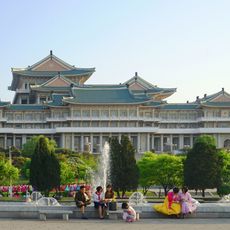
Korean Central History Museum, National history museum in Kim Il-sung Square, Pyongyang, North Korea.
The Korean Central History Museum is a large building in the center of Pyongyang that contains many exhibition spaces with artifacts spanning different time periods. The collections range from early tools and pottery to items from later eras, organized across multiple levels and rooms.
The museum was founded on 1 December 1945 by Kim Il Sung and first stood on Moran Hill. During the Korean War its collections were hidden and the original building was destroyed by US troops. It was rebuilt on Kim Il-sung Square in 1960, or according to some accounts 1977.
The museum's name in Korean is 조선중앙력사박물관. Its 19 rooms give extra space to Goguryeo and Goryeo, the states that had their capitals in Pyongyang, and a full-size model of a Goguryeo cavalryman in gilded armour stands among the displays. The narrative dwells on invasions repelled, such as the Liao incursions, the Imjin War and the General Sherman incident, while Goryeo's submission to the Yuan, tribute to the Qing and the Ganghwa Island incident are left out.
The museum stands at the north end of Kim Il-sung Square, so it is reached on foot from the square itself. It admits foreign visitors and tourists, but photography inside is prohibited. Its 10,500 square metres of exhibition space are divided into 19 rooms, so allow time to walk through them all.
The museum preserves ancient bone remains that researchers discovered decades ago at a specific excavation site, offering insight into how long the area has been inhabited. It also displays a replica of an early weapon type that is claimed to have been created before any other similar device elsewhere.
The community of curious travelers
AroundUs brings together thousands of curated places, local tips, and hidden gems, enriched daily by 94,023 contributors worldwide.