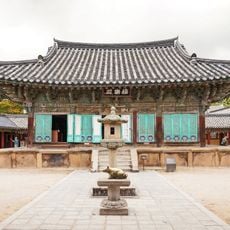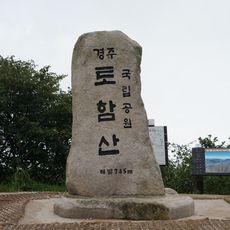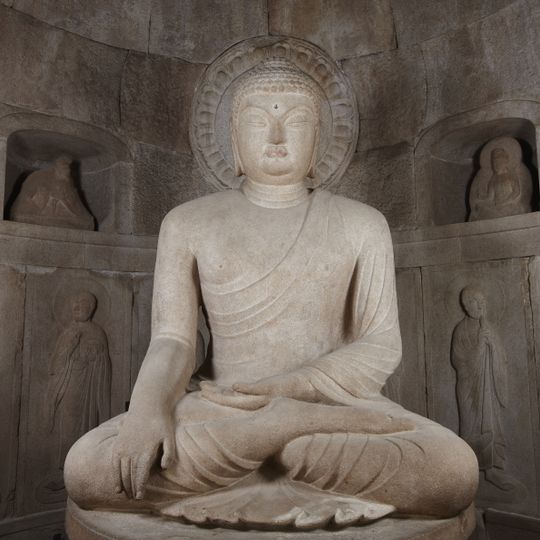
Seokguram, Buddhist temple on Mount Toham, South Korea
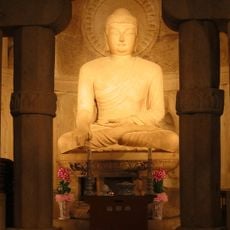
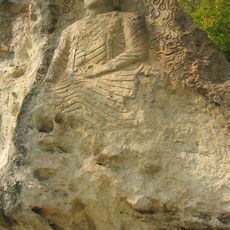
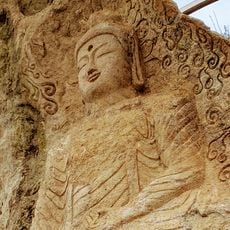
Seokguram is a hermitage of Bulguksa whose main shrine is an artificial grotto of fitted granite blocks on the slopes of Tohamsan. An arched entrance leads through a rectangular antechamber and a corridor lined with bas-reliefs into a domed rotunda about 6.7 metres across. In the centre sits a 3.5-metre seated Buddha on a lotus pedestal, with a lotus-petal roundel carved on the wall behind its head and ten small figures in niches above the reliefs.
Kim Daeseong, a Silla prime minister, began building the grotto in 751 as Seokbulsa, and the court completed it in 774, shortly after his death. It was repaired in 1703 and 1758, then dismantled and rebuilt by the Japanese colonial administration between 1913 and 1915, which poured concrete behind the stone walls.
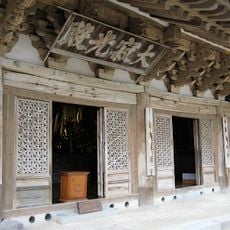
The name Seokguram means "stone cave hermitage," though the hermitage's own name uses the character for "hermitage," not "rock." According to the Samguk Yusa, Kim Daeseong built the grotto for his parents in a previous life, while Bulguksa was for his parents in this life. The grotto is open to the public only on Buddha's Birthday each year.
The interior can only be viewed through protective glass panels that shield the artifacts inside. This arrangement maintains steady temperature and humidity conditions to keep the stone carvings and statues in good condition.
The halo behind the main Buddha is the only asymmetrical element in the grotto: it is carved as an ellipse so that, seen from a height of about 160 cm, it appears as a perfect circle. Scholars read this as evidence that the average Silla man stood around 160 cm tall.
The community of curious travelers
AroundUs brings together thousands of curated places, local tips, and hidden gems, enriched daily by 93,473 contributors worldwide.