Seokgatap, Buddhist stone pagoda at Bulguksa Temple, South Korea
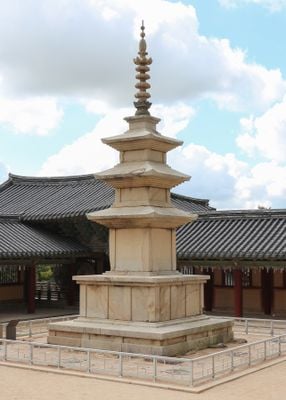
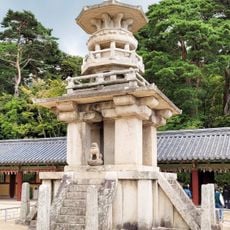
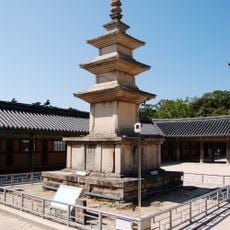
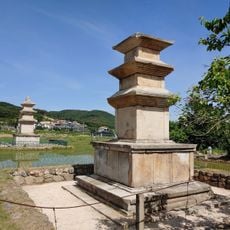
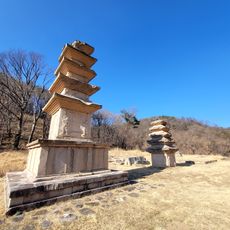
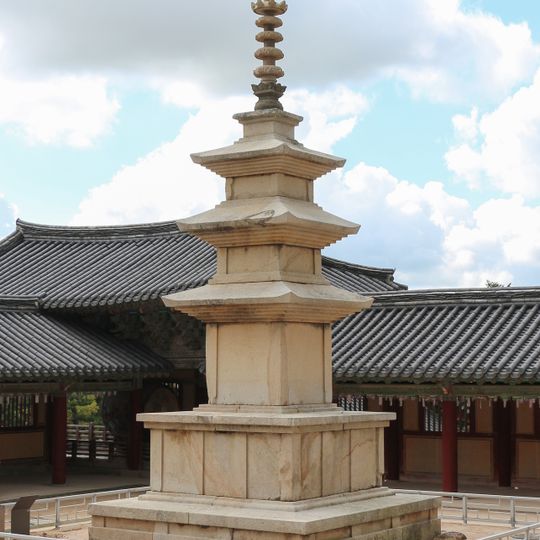
Seokgatap is a 10.75-meter stone pagoda of light grey and beige granite, standing on a two-tiered base with a square foundation of large flat blocks. Its three stories rise in a 4:3:2 ratio, each roof separated by a plain rectangular block, and the upper portion narrows toward a slender finial of stacked rings. The faces bear no carvings, and eight lotus-flower stones surround the base.
The pagoda was built in 751 CE during the Silla Dynasty when Kim Daeseong oversaw construction at Bulguksa Temple as part of a major Buddhist expansion. It formed part of a larger building program that shaped the entire temple complex.
The pagoda's original name, Sakyamuni Buddha's Constant Preaching of the Dharma Pagoda, links it to the Lotus Sutra, where the Buddha Sakyamuni preaches while the past Buddha Prabhutaratna testifies to his teaching. That is why it faces Dabotap, the pagoda of Prabhutaratna, as a pair. A legend calls it the Shadowless Pagoda: the Baekje mason Asadal built it, and his wife Asanyeo, forbidden to disturb him, drowned herself in the pond below.
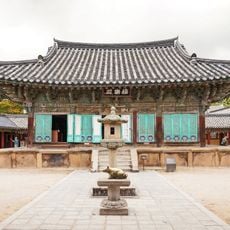
Seokgatap stands in the courtyard in front of Bulguksa's main hall, directly facing Dabotap, so both pagodas can be seen from the same spot. The stone base rests on a natural rock outcrop; look underneath the platform to see the dressed stone. The pagoda has no interior access.
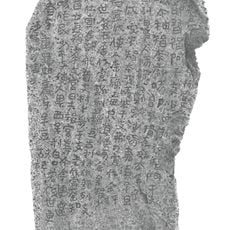
In 1966 thieves tried to force the pagoda open but failed; during the repair that followed, on 13 October 1966, a sarira hole 41 cm square and 19 cm deep in the second-story body stone was opened. Inside lay a gilt-bronze reliquary, a bronze mirror, a miniature wooden pagoda, silk, perfume and beads, plus the Mugujeonggwang Great Dharani Sutra, the oldest surviving woodblock print in the world.
The community of curious travelers
AroundUs brings together thousands of curated places, local tips, and hidden gems, enriched daily by 94,046 contributors worldwide.